
In September 2025, Figure of San Jose announced a funding round of one billion dollars at a valuation of 39 billion. Eighteen months earlier the valuation stood at 2.6 billion. To this day it has not published any revenue figures.
How big the market behind it will be, nobody knows. Goldman Sachs estimates the entire global market for humanoid robots in 2035 at 38 billion dollars. Figure alone is worth more than that today. Where nobody can verify the future, the valuation goes to whoever tells it most convincingly.
Anyone building technology themselves knows the mix a headline like that sets off. Respect for what is being built there. Perhaps a little envy too. And underneath it the nagging thought that your own technology is at least as good. Why can we not raise capital like that?
Figure is Brett Adcock's third venture-backed company, after the talent marketplace Vettery, sold to Adecco for a never officially confirmed price of a good hundred million dollars, and the air taxi maker Archer Aviation, which he took public through a SPAC merger in 2021. He has since founded two more. Industries that at first glance have nothing to do with each other, and in all of them the same thing stands out. The weight given to the brand.
For Figure, Adcock brought in Red Antler, the agency behind Casper and Allbirds. The same agency that had already branded his air taxi startup Archer. You do not have to consider Figure's valuation justified. But you do have to acknowledge that someone here understands the value of narrative and brand precisely enough that his brands are the benchmark in the industry.
Back to the 39 billion valuation. Up to August 2026, 8.7 billion dollars of venture capital flowed into humanoids. In 2025, a good 20,000 humanoid robots were built worldwide, of which around two thousand went into real deployment, mostly in pilot projects.
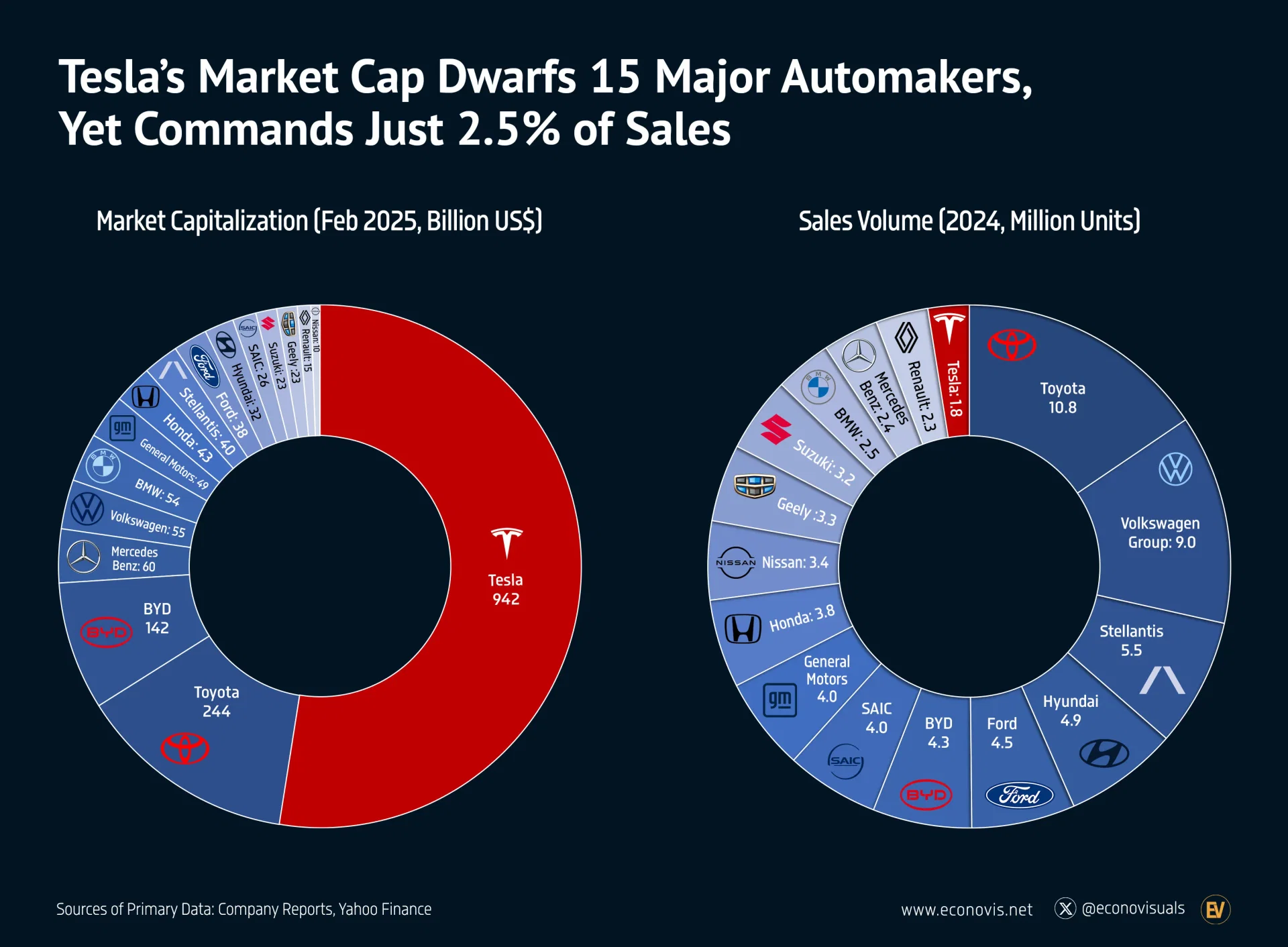
Tesla demonstrates the same principle on the stock market. In early August 2026 Tesla was worth around 1.3 trillion dollars. That is more than six times Volkswagen, BMW and Mercedes combined, and the share trades at roughly three hundred times annual earnings. For comparison, Volkswagen's price-earnings ratio sits between 5.7 and 7.3 depending on the estimate.
The car business cannot explain that gap, and the market does not even try. Anyone buying the share at this level is not buying margin per vehicle delivered. They are buying a bundle of bets on gigantic future markets, full self-driving, energy storage, physical AI in the shape of robots
On the other side of these valuations sits someone with very little time. DocSend, one of the tools pitch decks get sent through, shows founders at one in the morning which investor spent how long on which slide. According to its own data, a deck stays open for around two and a half minutes on average. Those decks often hold the fruit of years of work. Doctorates, patents, prototypes, whole careers. All of it read in the length of a pop song.
There is an uncomfortable explanation for the gap between the two. In the first step nobody assesses a technology. What gets assessed is its story, and if the story stays small, the company stays small too. Up to that point the technology has nothing to do with it.
The road from research to prototype, and from prototype to series production, is not smooth. Special cases, compromises, things that work in the lab and fall apart on the thousandth cycle in series manufacturing. Anyone building at the edge of today's technology needs no explanation of that. That work is the real achievement, and from the outside it is invisible. The trouble is that exactly this mess slips into the communication of many technically minded teams. What goes out is every detail of how the problem is being solved. What should be told is what the solution means for the world, and what that world looks like once the problem is gone.
Founders are rightly fascinated by what they have built, by the solution that never existed before. For someone with a financial interest, the ingenious construction is only proof that you can deliver. The reason to buy is a different one. What is interesting is what the solution stands for, why you are the right person, which field it plays in and what it makes possible in five years. That is exactly what you should be able to tell in two and a half minutes.
Why that is so was worked out by the psychologists Reber, Schwarz and Winkielman in a major review in 2004. The principle is called processing fluency. The more easily the brain processes a piece of information, the better it likes it, and the judgement about the form bleeds into the judgement about the substance. Put two decks in front of an investor. With the first, they have to work out for themselves what the company actually is, who to compare it with and what it could become. With the second it is right there. The second feels easier, and that is exactly why they take it for the better company.

Brand and communication are the layer around the technology. I call it the abstraction layer, a term from software development. An abstraction layer hides what is messy underneath and offers the outside world a form it can work with. It packages complicated science and engineering so that a person can grasp it in two and a half minutes. Every abstraction is a reduction, and reduction hurts, because things fall away that years are attached to. The reduction happens either way, though. If you do not make it yourself, you leave it to the reader, and the reader only has the boxes they already know. Then your new joining process becomes "something like welding, only more expensive", and inside the welding box you get compared on price rather than on what the process makes possible. Or you become the German counterpart to some company from the Valley, and from then on somebody else defines you. Whoever does not make the reduction themselves gets the crudest one in circulation.
The first is the mission, and it is the foundation for the next. On his personal homepage, Adcock describes the purpose of Figure in five words, "to give AI a body". As simple as it is brilliant. Not a word about actuators or sophisticated algorithms. A mission of that kind does two things. It gives capital a direction to invest in before the product is ready for series production. And it works inwards, on the people you want to attract. The best people do not leave secure corporations for a startup with no revenue because of the salary. They move for a mission they believe in, and that mission has to be articulated before anyone can believe in it.
The second is the category, and it determines who you get compared with. Sometimes the right category is one nobody has claimed yet. In 2008 Universal Robots sold its first robot arm that worked directly alongside people without a safety cage, and turned that into a category rather than a footnote on the datasheet. The collaborative robot, the cobot. The term had existed since 1996, nobody had claimed it. Today, with more than 100,000 cobots sold, Universal Robots owns the category. Think cobot, think Universal Robots.
The third is the name, and it decides whether your product can be passed on when you are not in the room. Waymo calls its product The Waymo Driver. A driver. Not a word about the machine underneath, even though one of the most complex software stacks in operation is working down there. A name that carries the result travels on its own, with no engineer alongside to explain it.
The fourth is the imagery. It can show three things. What the machine can do today. What it achieves in use. And what the world looks like once the machine is working in it. For a company before revenue, the vision is often the only thing available, and it is more honest than it sounds. It tells the category and says openly "this is how it will be" rather than "this is how it is". Boston Dynamics could pick the first register because the machine already existed. The early videos were lab recordings. They showed dryly what was possible, with no staging and no promise of the future, and that is exactly what made Boston Dynamics world famous.
Many European deep tech companies have world class technology and a story that trails far behind their substance. In doing so they hand the category to whoever presents themselves better.
Anyone who wants to close that distance has to face two honest questions. Which category does someone seeing you for the first time put you in, and is it one you can win? And can an investor pass your product on in one sentence when you are not in the room?
In the end the technology decides who survives in the market. But the story decides who gets the capital to compete at all. Anyone building world class technology should tell a world class story.
If your story is trailing behind your technology and you want to change that, write to me. With Lucent I help deep tech teams build that layer.