
In early October, Tesla pushed the nightly shutdown of its robotaxi service in Austin back from 10 pm to 11 pm. The main thing still to solve, Elon Musk wrote on X, is not running over pets that are hard to see at night. He was “literally trying to avoid grey kittens on grey tarmac in the dark”. Tesla's robotaxis drive on cameras alone. Waymo's latest vehicle generation carries 13 cameras, 4 lidars and 6 radars, and the service runs around the clock.
Behind this sits a dispute that has split the car industry for years. Musk considers extra sensors a dead end. Lidar and radar make a car less safe, he wrote in August 2025, because it is unclear which one the system should believe when the sensors contradict the cameras. Waymo sees it exactly the other way round. In the company's view, lidar and radar provide the redundancy that is needed when the cameras can make out very little. Both sides have a point. Every sensor misses something another one would catch, and every sensor you add is one more that can contradict the others.
That dispute is now arriving in humanoid robotics. So far, though, the big money there flows into the brain, meaning the AI models. In January, Skild AI raised 1.4 billion dollars for a model that, by its own account, is meant to control any robot. Machine vision group Cognex currently puts the entire market for robot perception at 600 million dollars. If that estimate holds, a single funding round for a brain is more than twice the size of the whole market for eyes.
On 6 October I was at VISION in Stuttgart, the trade fair of the machine vision industry. I talked to companies there that want to give machines better eyes. Two of their approaches could shift the front lines in the old argument between camera and lidar. One is a chip that counts individual photons, the other a lidar that fits on a single chip. I went from stand to stand with one question. If the camera keeps getting better, is it enough on its own?
I have a five-dioptre prescription. When I take out my contact lenses, my head is the same and my hands are the same, and still I am worse at almost everything, because what my brain has to work with arrives in worse shape. Cognitive and motor skills can be as good as you like. Once the input is limited, everything downstream gets hard.
It is essentially the same for a robot. Its model only gets what the sensors deliver. Whatever they miss, it can at best fill in from experience, the way we sense in the dark where the light switch is. That remains a guess.
We humans do have one advantage over the robot. Our eyes are, in a sense, part of the brain. The retina belongs to the central nervous system and pre-sorts what it takes in. What more than a hundred million sensory cells pick up, it condenses into roughly one million nerve fibres. Eye and brain evolved together and are tuned to each other. In a robot the two are developed separately, often by different companies, and a lot gets lost at the seam.
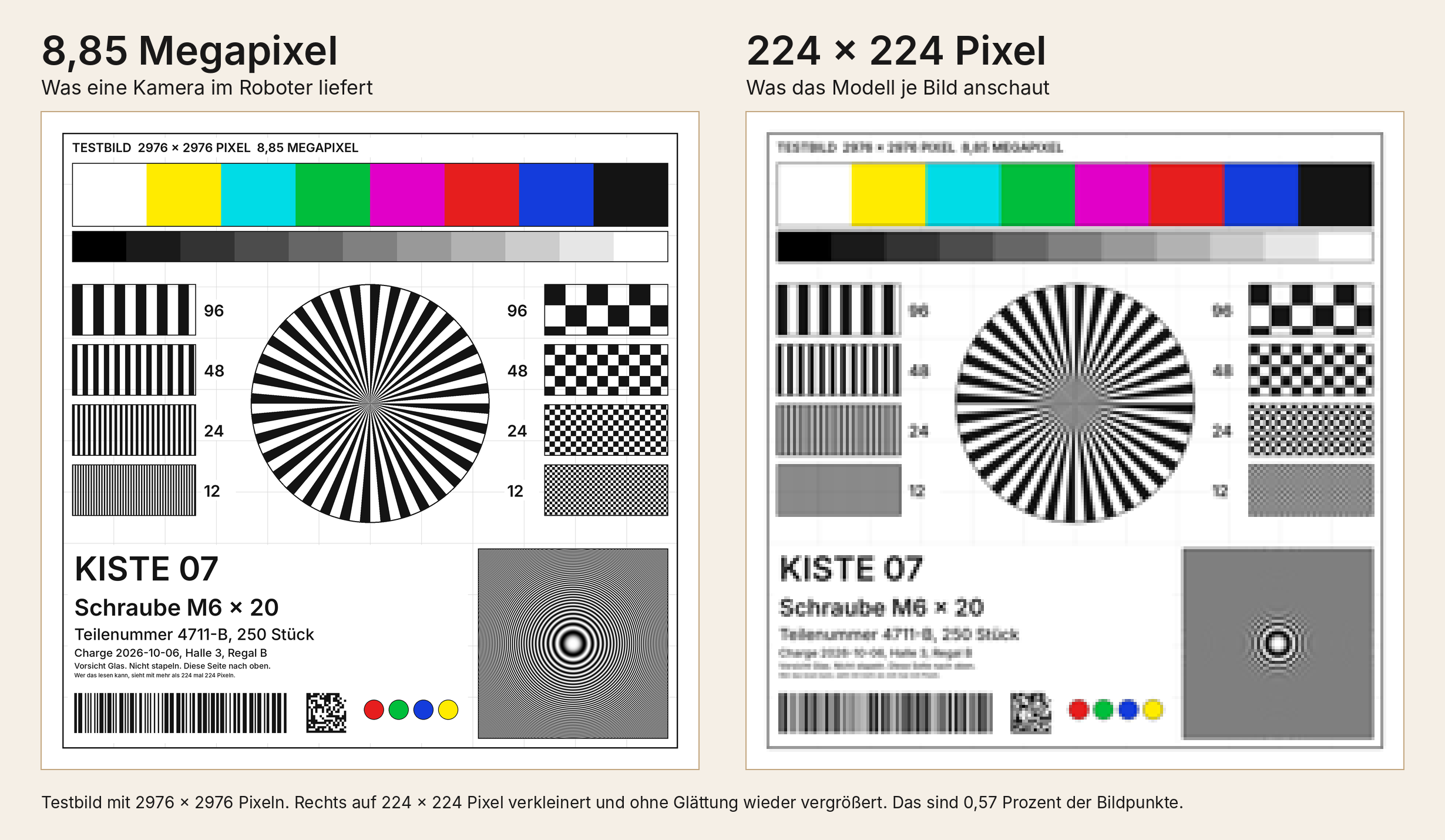
What surprised me most in the research was how little of the image actually reaches the brain. Where the developers of the major robot models state the resolution at all, it is low. OpenVLA, NVIDIA's GR00T N1 and π0.5 from Physical Intelligence work with images of 224 by 224 pixels. That is the size of a thumbnail in a photo gallery. For comparison, each of the two cameras in 1X's NEO delivers 8.85 megapixels. A model working at 224 by 224 pixels keeps less than one percent of that.
The reason is compute. Every extra pixel costs computing time, in training and later inside the robot. The authors of OpenVLA also tested 384 by 384 pixels. In their evaluations the model did no better, while training took three times as long. So my comparison with the glasses is only half right. The robot's cameras already deliver far more than its model processes. Sharper cameras will therefore not help much for now. That is the strongest argument of those who think cameras and a good model are enough. There is one limit, though, that even the best model cannot move. It cannot recognise what is not in the image in the first place. The grey kitten on grey tarmac at night is exactly that case.
Of course, this is where a robot differs from us. We have two eyes in our head and depend on visible light. A machine can carry its sensors anywhere on its body, or even have them mounted in the room. And it can actively probe its surroundings, with laser light, with radio waves or with sound.
Which of these options it needs depends on what it has to see, and for a humanoid that is something different than for a car. A Waymo's cameras, according to the company, detect pedestrians and stop signs from more than 500 metres away. A humanoid works at arm's length. That gives it three jobs. It has to see what its hands are doing, precisely enough to grasp. It has to find its way around a room between shelves, glass doors and people, in any light. The third job is the most demanding. It has to detect the people next to it reliably enough to stop in time. For all of this it has little space and little power, because it carries its sensors, computer and battery itself.
Manufacturers have long been making use of the fact that sensors can sit anywhere on the body. Figure puts a camera in each palm of the Figure 03, because the cameras in the head lose their view as soon as the hand reaches into a cabinet.
One camp bets on cameras and a strong model alone, as Tesla does in cars. Figure and 1X name no other sensor for vision. The other camp also gives the robot sensors that actively scan their surroundings. Agility's current Digit carries a lidar alongside its cameras, and Unitree gave its first humanoids, the H1 and the G1, a 3D lidar.
The camera is a given in both camps. RealSense, by its own estimate, is in around 80 percent of all humanoid robots. Its depth cameras are more than a classic camera, though. They project an infrared pattern onto the scene that is invisible to us, so that distances can be worked out even on a bare wall or in low light. So they already bring their own light.
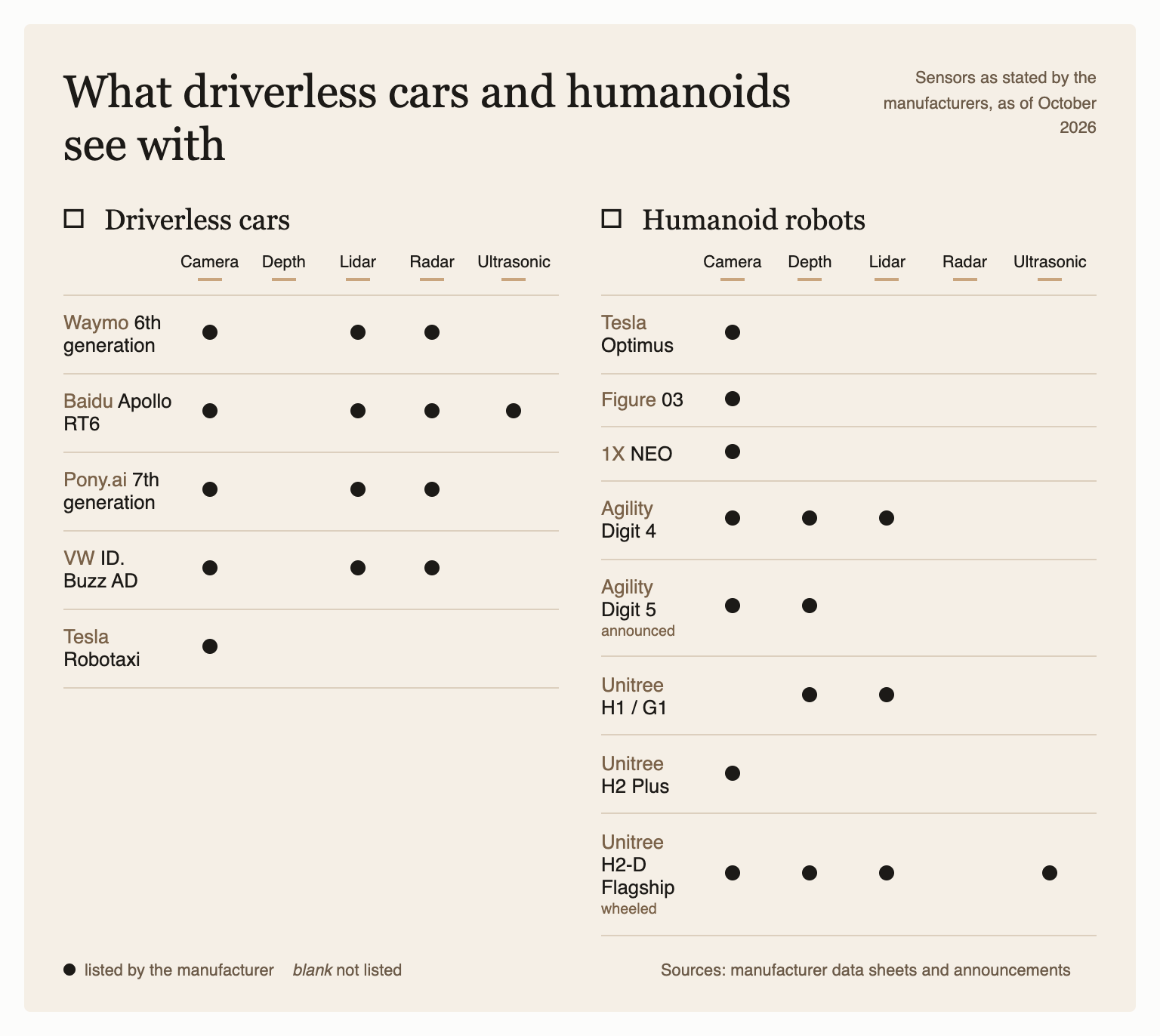
Which sensors cars and humanoids carry, according to their manufacturers, as of October 2026
For work with the hands, almost everything speaks for the camera, for three reasons. The first lies in the model itself. The major robot models grew out of vision-language models trained on images and text from the internet. They therefore expect camera images as input, and for further training, too, camera footage is by far the most plentiful material, right down to videos of people at work. The second reason is that a camera image shows what something is. Colour, lettering and material can all be read from an image. Lidar and radar mainly measure where something is. The third reason is practical. A camera is small and frugal enough to fit in a palm.
The camera has weaknesses too. It has to calculate distances instead of measuring them, and fast movements blur in the image. For fast movement there is the event camera. In it, each pixel reports on its own when its brightness changes. Because it does not expose whole frames, hardly anything blurs, and it copes with very bright and very dark areas in the same scene. So far it is used mainly in research, for example on fast drones. Its price is that it does not deliver a familiar image. Anything that does not move produces no signal, and the software behind it has to be written specifically for it. Above all, though, the camera needs light. That is Musk's problem with the kitten.
The most interesting answer to darkness is the SPAD, short for single-photon avalanche diode. A sensor of this kind counts individual photons and records when each one arrives. Canon has shown one that detects pedestrians 120 metres away at 0.1 lux, according to Canon about half as bright as a night with a full moon.
At VISION I talked to Sebastian Bauer, the CEO of Ubicept, which develops the software that turns SPAD data into images a machine can work with. In low light, a conventional camera has to choose between a long exposure that blurs motion and a short one that leaves the image noisy. A SPAD counts the photons one by one, and Bauer says this resolves that trade-off. In the interview he goes further. SPAD, he says, makes cameras without their own light source so much more capable that active sensors such as lidar could be needed less often in some automotive applications, or even become unnecessary.
That would be good news for the camera camp. But even a SPAD needs a few photons to count. Where there are none, it has to bring its own light, and Ubicept describes how the same sensor then measures distances with a light pulse. At that point it works like a lidar.
The lidar makers see it the other way round. When a machine has to find its way around a space, lidar is the default today. The sensor emits its own laser light, measures how long it takes to return and delivers distances directly, in the dark just as in daylight. Price is no longer the obstacle. Unitree sells its own lidar for 419 dollars.
Classic lidar has three weak spots. Cheap lidars take glass for empty space, because the laser beam passes straight through. Cameras fare no better, since they usually see what lies behind the pane. Dust, smoke and fog scatter the laser light, just as they obscure a camera's view. And a lidar only measures where something is. Whether it is moving only becomes clear from comparing several measurements. In navigation, software can make up for some of this.

To a cheap lidar, a freshly cleaned glass door is empty space.
On a fourth front, a lot is happening right now. For a long time a lidar delivered only points and no colour image. In May, Ouster unveiled a lidar that captures colour and distance with the same chip. The detectors in Ouster's chip are SPADs, the same components as in the previous section. Ouster says its goal is to make cameras obsolete. Camera makers and lidar makers are thus betting on the same component, and each side believes it can replace part of the other.
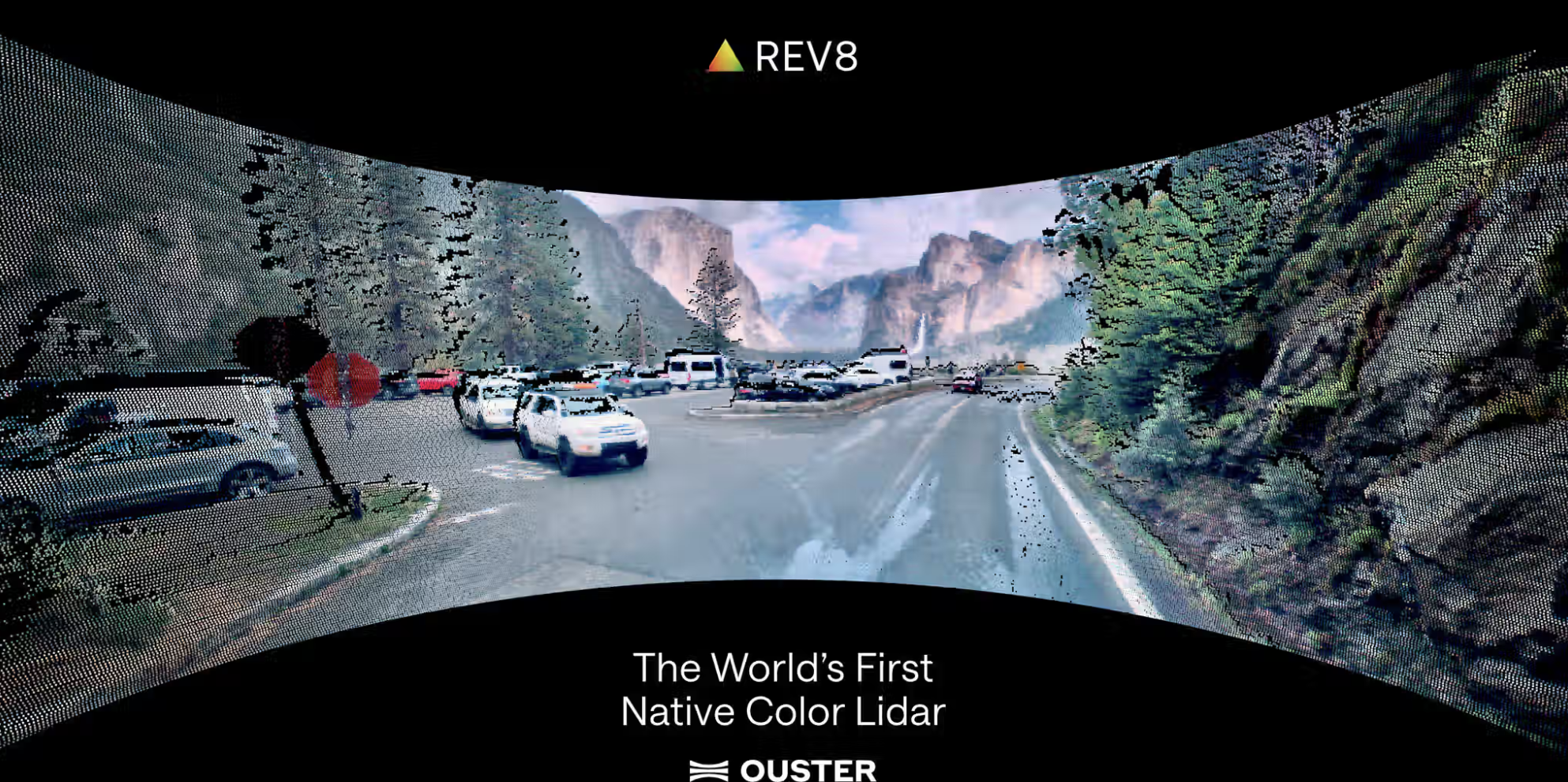
This is what the world looks like to a lidar that measures colour along with distance. Image: Ouster
Lidwave from Jerusalem is taking a different route. I spoke to co-founder and CEO Yehuda Vidal at the fair. The company's sensor reads off in a single measurement how far away something is and how fast it is approaching or moving away. A conventional lidar sends out a pulse of light and times how long it takes to come back. Lidwave treats light as a wave. The sensor superimposes the returning light on part of its own laser light. From that interference it reads the speed as well as the distance, via the Doppler effect, the same principle a radar uses with radio waves. Vidal calls this a fundamentally new idea. A robot sees at once whether a person is coming towards it, without comparing several measurements the way a classic lidar has to. According to the company, the sensor also captures colour like Ouster's, so every point carries colour, distance and velocity. Because the receiver only responds to light that matches its own laser, sunlight and glare do not blind it. In the company's own tests it keeps seeing through fog and dust. Laser, amplifier and detector sit on a single chip that can be manufactured in high volumes like other semiconductors, which strips out much of the production complexity of today's lidars. Lidwave says it is already selling its sensors, which are in use at many dozens of customers. The module for mass production is due in 2027.
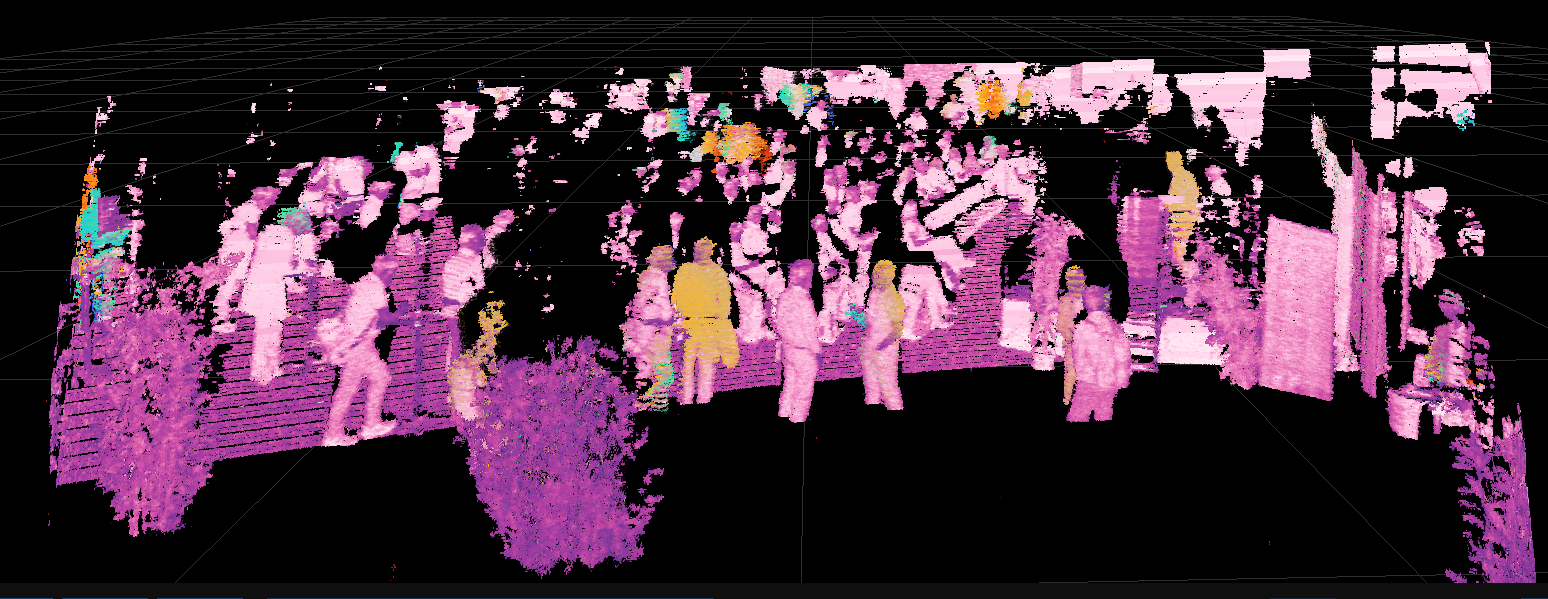
Image: Lidwave
Radar and ultrasound are the two sensors Tesla removed from its cars. Waymo kept radar. Radar has been part of driver assistance for years. Imaging radars go a step further. They resolve their surroundings finely enough for the echoes to form a spatial image. They measure velocity directly via the Doppler effect, down to small movements. They largely penetrate dust, smoke and fog, and darkness makes no difference to radio waves. They do not produce camera images of the people they detect. Their limit is spatial resolution. A radar draws contours far less sharply than a camera or a lidar, and it takes elaborate signal processing to separate individual objects in the echoes.
Ultrasound is the parking sensor in the bumper. It sends out sound and measures how long the echo takes to return. That works in dust and in the dark, and the sensors are cheap. Their range is short, typically up to about two metres, and they see far less detail than a camera. In robots, ultrasound so far turns up where obstacles are close, in robot lawn mowers, in driverless transport vehicles and in the chassis of the flagship version of Unitree's wheeled H2-D.
This is where Musk's objection is at its sharpest. When radar or ultrasound reports something the cameras do not see, which one should the system believe?
Which sensor to believe matters most when a person is standing next to the robot. Agility's Digit, according to the manufacturer, works in a cordoned-off cell behind barriers. Its successor, Digit 5, announced in September, is supposed to work close to people without those barriers from 2027, and Agility reports more than 300 million dollars in multi-year orders for it. The company's answer to Musk's question is the opposite of his own. Digit 5 detects people with “multiple sensor technologies”, in Agility's words, and an “independent safety controller oversees Digit's response” when someone comes within an unsafe distance. Agility takes on the extra sensors, and with them the question of which one to believe. Which sensors those are, the company does not say.
The idea is as old as functional safety itself. On industrial machines, the safety controller has long run separately from the control system. Synapticon, a maker of drives and safety electronics near Stuttgart, has been working on this for humanoids since 2024. In its architecture, AI-based scene analysis is kept clearly separate from the deterministic safety loop.
Sonair from Norway approaches safety from the sensor side. Its ADAR builds a 3D picture of its surroundings from ultrasound. According to the company, it is compact enough to be built into a humanoid. The sensor's limit is range, five metres for the safety function.
The question of camera, lidar or radar comes from the car industry, where it is about a single task, driving. A humanoid has several tasks, and the answer is different for each. For the hands, the camera is hard to beat. To find its way around a room in any light, it is not enough on its own, and lidar is a given. Agility and Synapticon keep safety apart from the model. Which sensor that safety system should rely on is still open.
At the same time, the lines between the sensors are blurring. Camera makers and lidar makers are betting on the same chip. So I can well imagine that a humanoid will end up with a mix of sensors that nobody builds in this form today. On one point Musk is right. That mix does not come for free, because every additional sensor costs power and compute and has to be coordinated with the others.
I am curious how you see this if you build these machines or want to bring them into your hall. At which task does the camera stop being enough for you?
About Marc Eyrich: Hands-on external communications lead for physical AI and robotics companies, based in the Stuttgart region. Has a background in filmmaking and directing TV commercials. For over ten years he has done brand communication for tech companies, most recently in-house in robotics. Today he runs Lucent, where he helps physical AI companies communicate the value of what they build.