
Venture investors have put eleven billion dollars into humanoid startups this year, according to Dealroom, more than double the previous record. The word that travels with this bet is abundance. Sam Altman writes that intelligence and energy will become "wildly abundant" in the 2030s. Jensen Huang puts Physical AI at 50 trillion dollars, and Tesla's Master Plan Part IV carries the subtitle "Sustainable Abundance". I hear the word a lot myself, from very different people, and every time I wonder what exactly it is supposed to mean.
The dream behind it is old. In 1567 Pieter Bruegel painted the picture known in German as Das Schlaraffenland. The word means the mythical land of milk and honey, where nobody works and nobody goes hungry. A peasant, a soldier and a scholar lie sprawled under a tree, full to bursting. The roof next door is tiled with cakes, and a roast pig trots past with a knife stuck in its back. The people who invented this fairy tale knew hunger. They were looking back on a Middle Ages of failed harvests, famine and plague.
To the people of that time, our everyday life would be the Schlaraffenland. The supermarket sells everything, and hot water comes out of the tap every day. Many of us own a car and could buy a ticket to almost anywhere in the world tomorrow. So aren't we already living in abundance?
The tech community clearly means something else when it talks about abundance. Here I want to work out what that is. Abundance of what, for whom, and are we being told a fairy tale?
The investor Marc Andreessen names the yardstick for abundance himself in his manifesto, and it is falling prices. Take the car. At mass-market manufacturers, the average car contains 880 dollars of assembly labor, according to Oliver Wyman. Take that labor out completely and a 45,000-dollar car still costs just over 44,000. So a humanoid on the assembly line barely makes your car cheaper.
Those 880 dollars are only the final step, though. Most of a vehicle's cost sits in materials and purchased parts. Every seat, every wiring harness and every ton of steel has someone's work in it too, all the way down to the mine. Carmakers do not break that out for a single car. For the world economy, the ILO puts labor's share of income at just over 52 percent. Roughly half of whatever you pay for anything ends up as someone's wages.
If robotics and AI are to push prices down on a large scale, wages have to disappear from the whole chain, from the ore to the dealership. Sam Altman described that scenario back in 2021. Once powerful AI enters the workforce, he wrote, the price of many kinds of work will drop toward zero. In his account, that price is what drives the cost of goods and services.
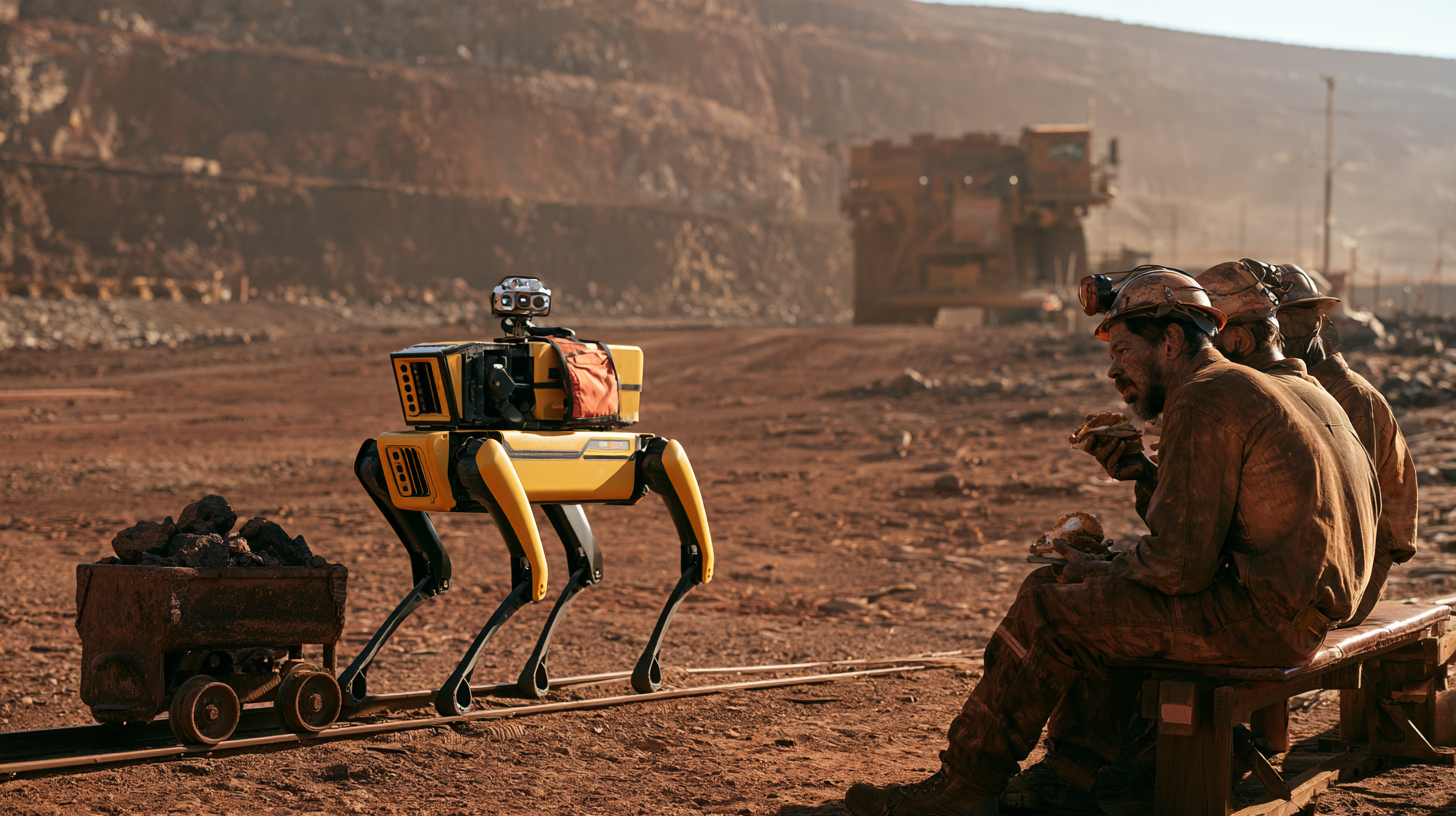
Lunch break at the open-pit mine.
That takes the ambition far beyond the assembly plant, and Jensen Huang spells it out most clearly. Warehouses, logistics networks, roads, cities, the entire industrial economy have so far been almost untouched by software, he says. That is his 50 trillion.
Adam Jonas comes at it from the other side. He made his name as an auto analyst at Morgan Stanley and is now the bank's strategist for robotics and embodied AI. In May 2025 he sized the humanoid market like this. Four billion people work worldwide, for 10,000 dollars a year on average, which adds up to a wage bill of 40 trillion dollars. He is counting all work, including the kind done at a desk. The more interesting way to size the market, he said, is the substitution of that labor.
Huang and Jonas are pointing at the same block, the last big stretch of human work that has never been scaled. It covers construction, care, logistics, restaurants and cleaning. In the EU alone, health and social care employ just over 23 million people, according to Eurostat.
Germany will be short of up to 690,000 care workers by 2049, according to its Federal Statistical Office. For decades this kind of work could hardly be sped up. You cannot compress an hour of care into forty minutes, and the same is true of moving a household. Wages there rise anyway, because they have to keep pace with industry or nobody would do the job. Economists call this cost disease, after William Baumol.
Figure's 2022 master plan names its entry market as "over 10 million unsafe or undesirable jobs in the U.S. alone". Internal Amazon documents seen by the New York Times show how far this can go. The robotics team wants to automate 75 percent of operations, which would make around 600,000 hires in the U.S. unnecessary. Amazon calls the documents the view of a single team, but the direction is clear all the same.
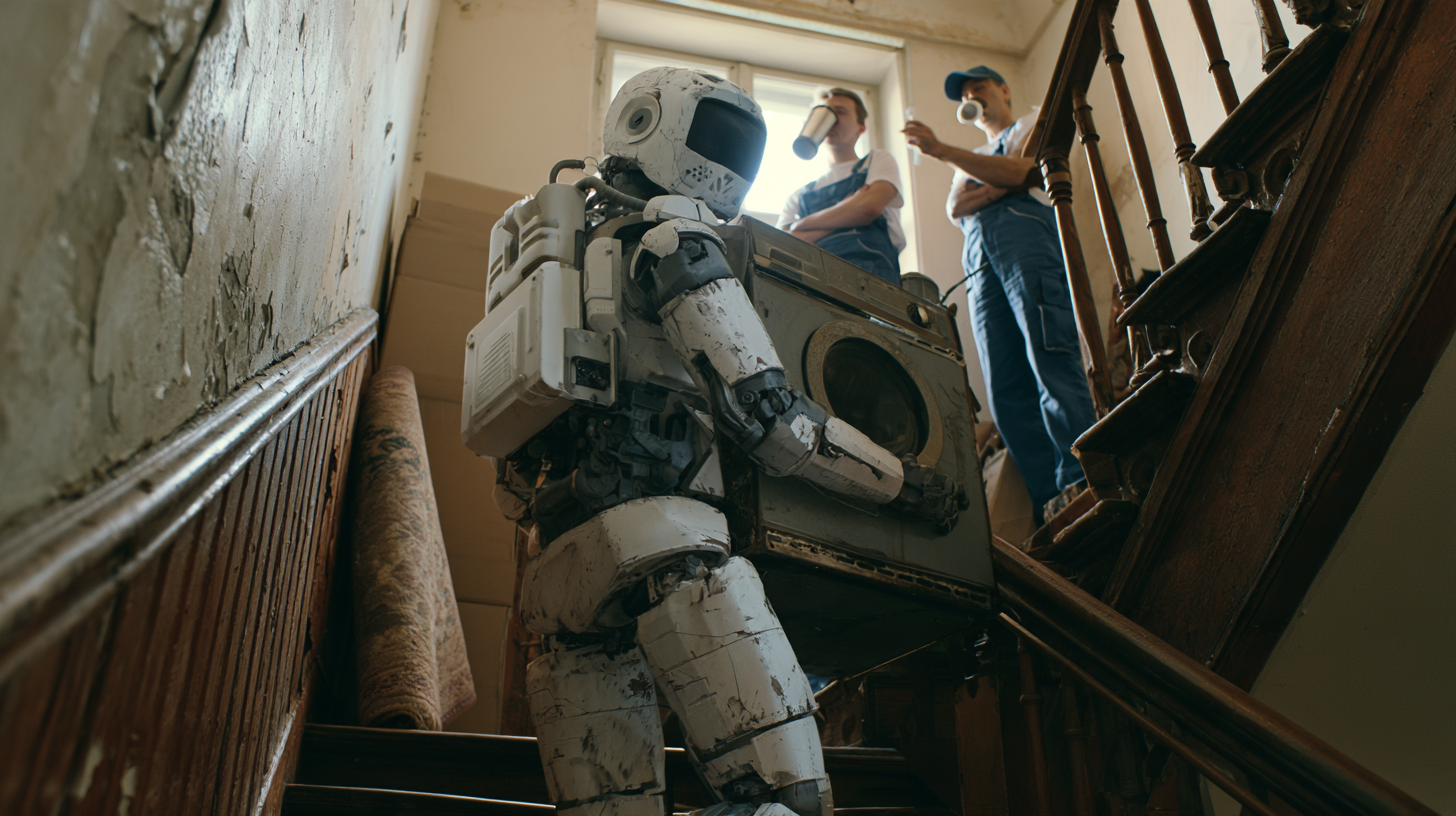
The washing machine has to go up to the fourth floor. His coworkers are making sure he does it right.
When wages drop out of the chain, the money resurfaces in one of two places. Either prices fall, and the abundance lands with the buyer. Or prices hold, and it turns into margin for whoever owns the machines. The Amazon documents put the saving at around 30 cents per item. Whether those 30 cents reach the customer or stay on the balance sheet and flow to shareholders is decided by the company and by competition.
If they stay on the balance sheet, what matters is who owns the machines. In the U.S., the top ten percent of households hold around 87 percent of all stocks and mutual fund shares, according to the Federal Reserve. In Germany, only one person in five owns stocks, funds or ETFs, according to the Deutsches Aktieninstitut. If abundance arrives as returns, four out of five Germans barely have a seat at the table. A stake in capital income is therefore one key to sharing in the value the machines create.
With food, abundance arrived long ago, and technology brought it. Around 1800 it took three farmers in Germany to feed one city dweller. Today one farmer feeds 139 people, according to the German Farmers' Association, and farming employs just over one percent of the workforce. The economist David Autor explains why there are still so many jobs. Tasks that cannot be replaced are complemented by automation, which makes them more valuable.
For the farmer living through it in 1855, things looked different. He lost his work in the fields and ended up on a factory floor, up to 16 hours a day for starvation wages. Millions made the same journey from the countryside to the city. In 1871 almost two thirds of Germans still lived in villages. Four decades later it was 40 percent. Hardly anyone at the time could foresee what industrial society would come to look like.
At first, things got worse for many. Hand weavers lost their livelihood to the machine, and in 1844 Silesia saw an uprising. The economic historian Robert Allen has the numbers for Britain. Over the first sixty years output per worker rose by 46 percent, while real wages rose by 12 percent. So the abundance was created. For two generations, though, it barely reached the people whose work produced it. In the end more people worked in textiles than before, because cloth became cheap and everyone wanted more of it.
The shift to an industrial society stretched across several generations. This time it is likely to go much faster. What grandparents, parents and children once lived through in turn could now fit into a single working life.
Back then most people were farmers doing hard physical work. Today many of us sit at keyboards in offices and have long lived in abundance. Personally I am optimistic, and a future in which people have no way to work strikes me as rather unlikely.
I want a future in which people no longer mindlessly lay cables or dig trenches, and leave the dangerous, monotonous tasks to machines. Machines can make us even more self-directed, faster and more productive, because they take the execution off our hands. That calls for a different kind of person than the industrial age did, when people obediently did as they were told. It calls for people who think creatively.
We need to prepare the young generation for that, while schools are still teaching for the 20th century. There will always be a way to create value. That is exactly why there will never be a world in which people have nothing left to do. Who would still want to sit at a loom for 16 hours today, or screw caps onto bottles by hand?
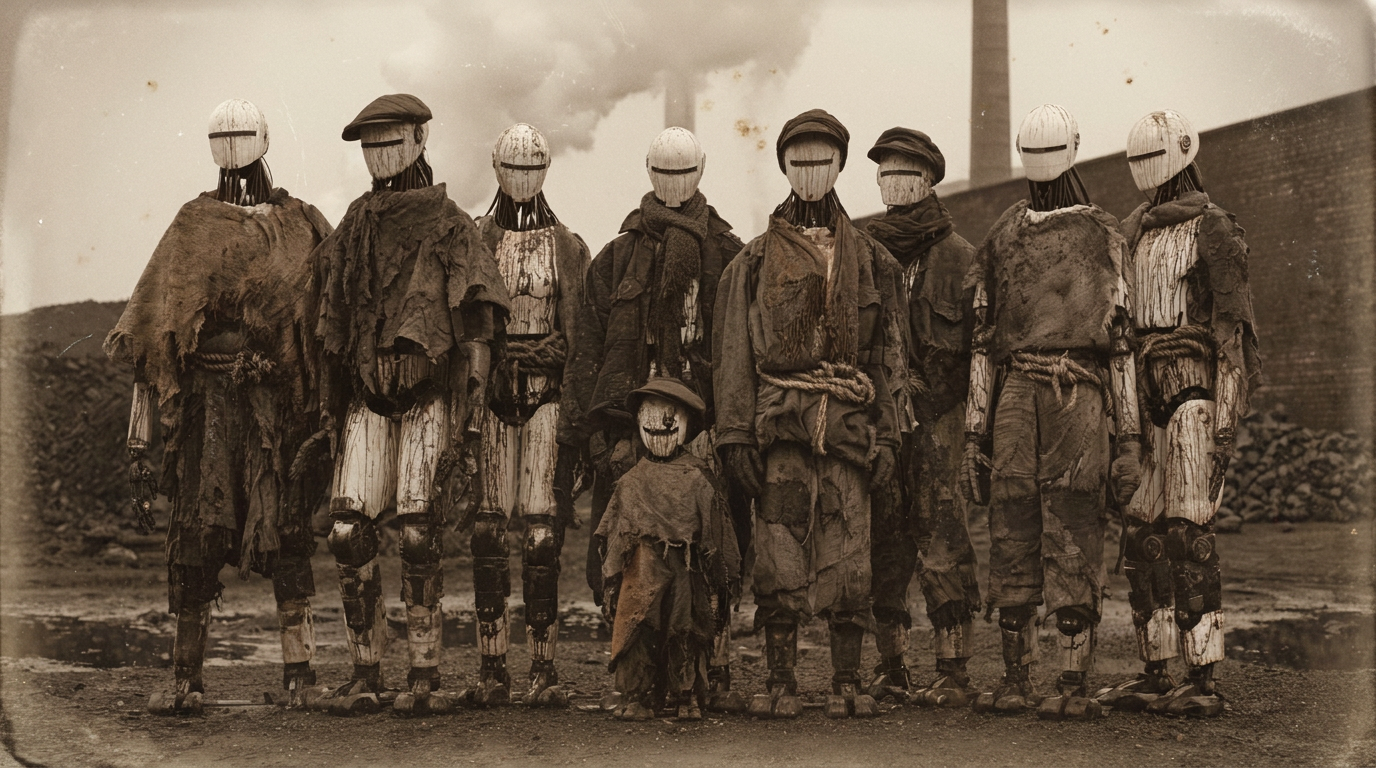
The new working class poses for a group photo. The 16-hour shift doesn't bother them.
The top ten percent of American earners now account for almost half of all consumer spending, according to Moody's Analytics. An economy that replaces wages with capital income on a large scale shifts income from those who spend it to those who invest it. Somebody still has to buy what rolls off the line in such abundance.
So could the answer simply be machines that earn capital income for everyone? Norway does this on a grand scale, funded by its oil revenues. The country's sovereign wealth fund owns almost 1.5 percent of all listed shares in the world and covers nearly a fifth of the national budget.
The more recent attempts are small and come from different political camps. In the U.S., newborns have been getting 1,000 dollars of seed money in an investment account since July, a project of the Trump administration. In Germany, parliament passed the Frühstartrente, an early-start pension, in October. The government is to pay ten euros a month into a stock account for every child aged six to 18, a total of 1,440 euros. The money stays locked until retirement at 65, and parents can add to it tax-free. I find the idea of saving for my daughter's retirement while she is still a toddler hilarious. She could first touch the money in 2089.
Altman himself proposed a fund in 2021 that would distribute company shares to every adult. This summer he negotiated with the U.S. government about handing the state five percent of OpenAI. MIT Technology Review did the math, and it comes to a one-time payment of around 320 dollars per household. The magazine describes the plan as more of a narrative than a policy so far. As a second income alongside a wage, these are pocket-money amounts for now.

First deposit into the retirement account. In 63 years the money will be hers again.
What abundance means depends on who is using the word. To people in the Middle Ages, it would have been our supermarket. To you as a buyer, it would be falling prices, and those are only a gain as long as you still have an income. China shows what happens otherwise. Producer prices there fell for more than three years in a row because factories make more than anyone buys. That is deflation, and the response is to throttle production or push the goods into foreign markets.
To someone who owns the machines, abundance looks different. When someone like Elon Musk talks about abundance, he may mostly mean production that no longer needs wages. Capital and labor, which have always depended on each other, would then go their separate ways. From an owner's point of view, that really is abundance. The word itself does not say what it is for everyone else.
Part of the answer therefore lies in ownership. If everyone owns a share of the machines, through funds, retirement accounts or equity stakes, capital income becomes a second income alongside work. For that to happen, ten euros a month would definitely have to turn into very different sums.
I am optimistic that people will keep creating value through what they do, even as machines handle more and more on their own. After this look at history, I rather doubt that abundance will distribute itself the way it does in the Schlaraffenland. What does abundance mean to you?
About Marc Eyrich: Strategic communication for Physical AI and robotics, with Lucent, based in the Stuttgart region. Has been communicating complex technology for more than ten years, for tech brands on the agency side and inside a robotics company. Builds Physical AI brands with founders, from positioning through identity and website to film.