
San Francisco, May 1848. A man steps off the ferry, waving his hat and a quinine bottle full of gold dust, and shouts “Gold! Gold! Gold from the American River!” until half the town has heard him. His name is Sam Brannan, and he is no prospector. He owns the store at Sutter's Fort, the one every man heading for the goldfields has to pass. Before his big entrance, he bought up every pick, shovel and pan he could find. By mid-June, three quarters of the town's men have left for the river. A pan Brannan bought for 20 cents now costs 15 dollars at his store. A few years later, he is known as the richest man in California.
Brannan wasn't the only one who did the math. On their way to the gold, the prospectors passed the same stations. At the merchant's they bought a shovel and a pan, at the next stall a map of the goldfields. The lucky ones met an old hand who showed them how to wash gold out of river sand. With their find they went to the assay office, where someone confirmed it really was gold. The people running these stations often got richer than the prospectors themselves. Robotics is in the middle of a new gold rush, and by now almost every station is run by the same company.
Jensen Huang showed how far that reach extends on October 21 at NVIDIA's developer conference, GTC Berlin. The shovel is the computer inside the robot. Jetson Thor, NVIDIA's computer for humanoids, runs the models that control it. The map is simulation. In Omniverse and Isaac Sim, a robot practices in a digital replica of its factory before it ever sets foot in the real one. The training course is run by Isaac Lab, NVIDIA's training environment, together with NVIDIA's own models such as GR00T for humanoids or Cosmos, which has learned how the physical world behaves.
Since June, NVIDIA has also been running the assay office. The Halos AI Systems Inspection Lab is accredited under ISO/IEC 17020, the international standard for inspection bodies, and checks robotic systems for safety. TÜV SÜD plans to use the lab's reports as part of its own test documentation. Certification is still done by independent bodies, with the lab supplying the paperwork.
Researchers who don't want to start from scratch can even buy the complete outfit from early 2027, robot included. Together with Munich-based Agile Robots, NVIDIA has built a reference robot that ships preassembled, computer and software included. Huang sums up the whole chain in a single sentence. “In order to create a physical AI system, you need three computers,” he says at Berlin's Tempodrom. The first trains the model, on the second the robot practices in simulation, and the third sits inside the robot itself. NVIDIA sells all three.
People like to say that NVIDIA sells the shovels in the AI gold rush. In robotics, that picture no longer goes far enough. There, NVIDIA offers almost the entire route, from the first training run to the safety inspection, and in Berlin Huang tells it as a partnership with Europe. To me, this chain is the truly interesting part of the keynote, more interesting than any single product announcement.
Huang likes to explain AI as a cake with five layers. Energy sits at the bottom, then chips, infrastructure and models, with applications on top. In his blog post on the subject, a humanoid robot is simply an application with a body. In Berlin he draws the cake once more and says of NVIDIA, “We are the computing layer.” Everything above it runs on that layer.
For Europe, he mostly brought praise. “You design machines, you operate factories, you discover medicine, you have extraordinary craft,” he says, adding that Europe's mechatronics are more precise than any other region's. Designing a chip, building a supercomputer and writing all the software for it, on the other hand, is “completely out of mind” for most companies in the world. Put the praise next to the cake and a clear division of labor emerges. Europe builds the machines, and everything they compute and learn with comes from NVIDIA.
The real move hides in an inconspicuous sentence. Robotics is fragmented, Huang says, because every task gets its own form factor. Phones and PCs improved so quickly because they are standardized and therefore built in huge volumes. “We need a robotics configuration that is as standard as possible.”
NVIDIA shows what such a standard looks like in autonomous driving. Hyperion is NVIDIA's platform for self-driving cars and robotaxis, a shared architecture of computers and sensors on which automakers build their driving systems. VW with its autonomous ID. Buzz AD, Volvo and Mercedes are among those building on it. “We turned this into an industry standard,” says Huang.
You know the pattern from smartphones, only with the roles reversed. There, manufacturers get Android for free, and Google earns from what comes preinstalled on every device, mainly search and advertising, plus the Play Store. With NVIDIA, the models are open and free, and the money is made on the chip underneath.
Huang supplies the urgency too. The ChatGPT moment for robotics, the point at which robots become useful as suddenly as language models did in late 2022, was “just around the corner” in January 2025. In January 2026 it was “here,” according to a press release, and in Berlin it is now “fast approaching.” For almost two years, then, this moment has been both here and on its way. Physicists call that a superposition, and as with Schrödinger's cat, the state is only decided when someone looks. For NVIDIA, the moment serves its purpose either way. Anyone who believes it is coming wants a seat at the table before the standard is set.
You can dismiss all of this as stagecraft, but on the substance Huang is right. According to an analysis by the Brussels think tank Bruegel, the EU has around two gigawatts of AI computing capacity in operation, the US 35 gigawatts. Toyota Material Handling Europe says it wants to use Omniverse and Isaac Sim to cut the commissioning time of autonomous solutions by up to 50 percent. Anyone building a robot today can hardly get around NVIDIA. Chip, simulation, training and models interlock, and most developers have been using them for a long time.

Today 35 vs. 2 gigawatts, by 2031 a projected 255 vs. 21. Chart: Lucent, data: Bruegel based on Europe2031.ai
At the same time, robotics is splitting into two geopolitical camps. Since late July, the US no longer approves new humanoids and robot dogs made abroad, citing national security, in a move aimed at China. Inside, many robots from both camps still run on the same chip. According to a report by the South China Morning Post, Unitree, AgiBot and UBTech were among the first users of Jetson Thor, just like Agility and Boston Dynamics. Chinese manufacturers are not entirely comfortable with this. Xpeng runs its humanoid Iron on its in-house Turing chip, which according to Xpeng president Brian Gu comes close to Thor. UBTech is hedging its bets. The company uses Thor and has also set up a joint venture for its own robot chips with the Chinese GPU developer MetaX.
NVIDIA's own reference robot shows how well this works together. The company unveiled the first one in Taipei on June 1, built on the H2 Plus humanoid from China's Unitree, with hands from Sharpa in Singapore. In Berlin, the stage belonged to the Agile ONE SN from Munich-based Agile Robots, with hands from Wuji. Different body, different hands, different sensors. What stayed the same is the Jetson Thor computer and the software running on it. At first glance, that looks like a contradiction of Huang's call for a standard configuration. In fact, it shows quite precisely what NVIDIA wants to standardize, namely whatever a robot computes and learns with. To him, the body is interchangeable.
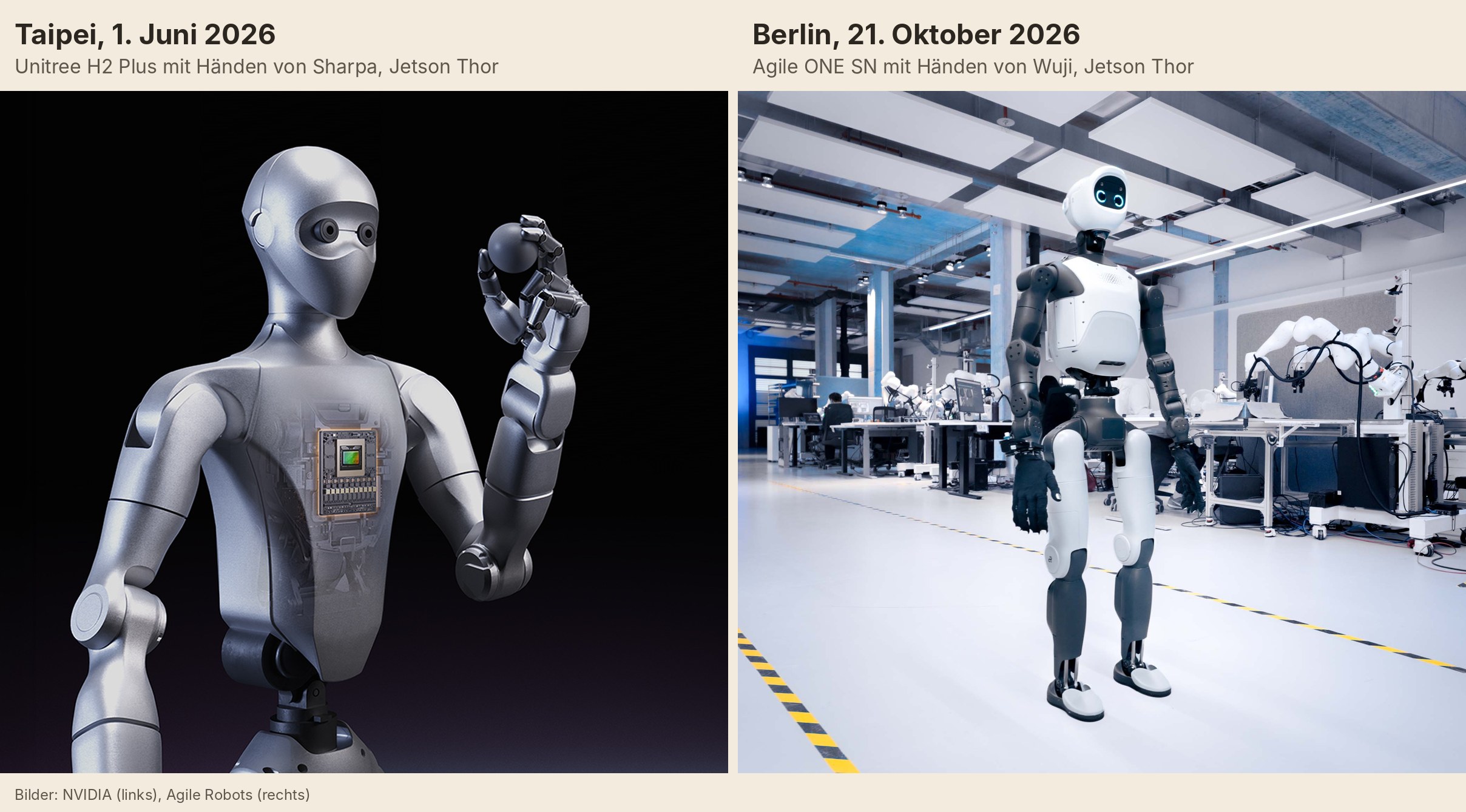
Two bodies, one computer. Images: NVIDIA, Agile Robots
The keynote ends with a song in the style of the Eurovision Song Contest. It praises the GPU as a better investment than oil and stocks, and in the chorus NVIDIA declares its love for Europe in several languages. A week earlier in London, Huang had said nothing pained him more than seeing one of the most technologically advanced countries “so far behind.” He meant Germany. At the Tempodrom he sounds like an old friend of the family. He recalls that NVIDIA's first chips were made in Europe and that MediaMarkt was NVIDIA's biggest customer in the early GeForce years.
On the shovel, Huang's verdict from London holds. The open question is how sovereign Europe can remain on this foundation, and Huang has an answer for that too. Anyone who fine-tunes an open NVIDIA model with their own data turns it into “sovereign intelligence,” he says. A company's knowledge and tools, he assures his audience, “belong to you.” So in this story, sovereignty means putting your data into an NVIDIA model that runs on an NVIDIA chip. To me, that looks more like a new dependency, just with a very friendly counterpart. How friendly it stays isn't up to Huang alone, though. In April 2025, the US government halted sales of NVIDIA's China chip, the H20, and in August it allowed them again in exchange for 15 percent of the revenue. For the more powerful H200, Trump demanded as much as 25 percent in December 2025. How sovereign anyone is with this technology also depends on who happens to be sitting in the Oval Office.
From the other side, the pressure comes from hardware. Unitree has been selling a humanoid since summer 2025 starting at 5,900 dollars, and even the new reference robot from Munich uses hands from the Chinese manufacturer Wuji. If NVIDIA takes over the computing and China builds the cheap bodies, what's left for Europe is mostly what Huang likes to praise. That means precise mechanics, machines that last many thousands of hours, and decades of experience with robots on real factory floors. Add to that a testing culture that customers around the world rely on. Yet right at the testing stage, NVIDIA is now standing in the doorway with its Halos lab.
A project Audi presented in Berlin shows what makes Europe strong in this position. In the Production Lab at its Ingolstadt plant, Audi is testing with Agile Robots whether mobile humanoids can pick parts from containers and lay them out in the right sequence for assembly. NVIDIA provides the simulation, Dassault Systèmes the digital twin. Audi brings the experience of a logistics operation that handles around a million picks a day and defines what the robot has to be able to do under real conditions. Huang named this treasure himself shortly before the keynote. German companies, he said according to Reuters, are sitting on a valuable trove of industrial data. As long as that knowledge stays on the factory floor, Europe is above all a good customer for NVIDIA. Whoever turns it into processes, inspections and guarantees gets a say in which robot ends up on the line.
If you're building a robot right now, this question of location becomes a very practical one. Perhaps it computes on Thor, learns with GR00T, practices in Isaac Sim and runs on the runtime NVIDIA calls Isaac OS. Its safety inspection might be done by NVIDIA's lab, while its joints and hands come from China. Then you are buying from the same merchant at almost every station, just as the prospectors did with Sam Brannan in 1848. That can be a very good business, as long as nobody in Santa Clara, Washington or Beijing changes the terms.
Brannan himself, by the way, died poor, after a costly divorce and bad investments. Things went better for a German immigrant from Buttenheim in Bavaria who arrived in San Francisco in 1853. Levi Strauss sold cloth to the prospectors, and when a tailor from Reno suggested reinforcing the seams of work pants with copper rivets, the two patented the idea in 1873. The pants stopped tearing in the mines, and the company is still around today. Anyone who isn't selling shovels in the robotics gold rush can still build what lasts longest in the mine. For a European robot maker, that's not a bad place to be.
About Marc Eyrich: Strategic communication for Physical AI and robotics, with Lucent, based in the Stuttgart region. Has been communicating complex technology for more than ten years, for tech brands on the agency side and inside a robotics company. Builds Physical AI brands with founders, from positioning through identity and website to film.