
Atlas dribbles a football for a World Cup 2026 campaign. In livestreams, humanoid robots now play football autonomously and millions watch. And worldwide, industry estimates put the number of humanoids doing genuinely productive work at a few hundred. The stage is full. The factory floor is almost empty.
I am not writing this as an opponent of the technology. I helped shape the communication of a humanoid manufacturer and saw how much serious engineering sits inside these machines. That is exactly why a sober look at the question the hype skips over is worth the time.
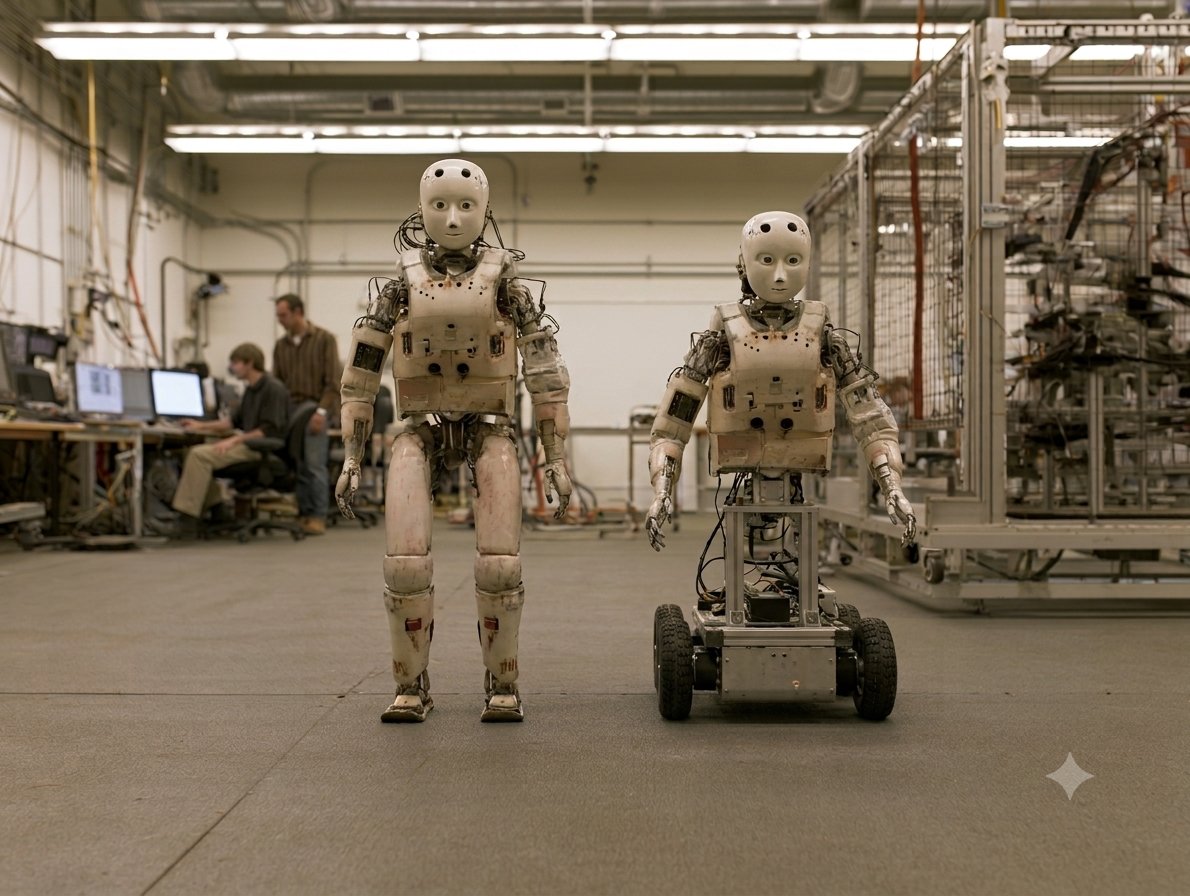
The strongest argument for the human form is economic, not futuristic. Our built world is designed around the human body. Doors, stairs, workbenches, tools, driver cabs. A robot in human form fits into that world without anyone having to rebuild the world. One form factor for a thousand tasks instead of a thousand special-purpose solutions.
The thing is, that argument holds for something other than what many people assume. It holds for reach, gripping height and two arms that can hold and join at the same time. It does not hold for two legs. A workbench sits at around ninety centimetres, and it does not care whether someone stands in front of it or rolls up to it. Two legs are not a requirement of the environment. They are a design bet.
And that bet has a price you can measure.
First, energy. Walking on two legs is heavy labour before the actual work even begins. A substantial share of the battery goes into keeping balance alone. Comparative measurements show that moving on wheels over flat ground costs a fraction of the energy that striding consumes; one overview of wheel-leg systems puts the saving at 70 to 80 per cent. IEEE Spectrum calls battery life probably the most critical bottleneck of the current humanoid generation. Every watt-hour that goes into balance is missing from payload and runtime.
A humanoid only stands as long as it actively balances. Every second of stability is a piece of computation. Cut the power, trip up the control loop, land one unexpected shove, and sixty kilos of metal go down with nothing to slow them. The rigid structures and the energy-hungry balance control of today's humanoids make falls dangerous.
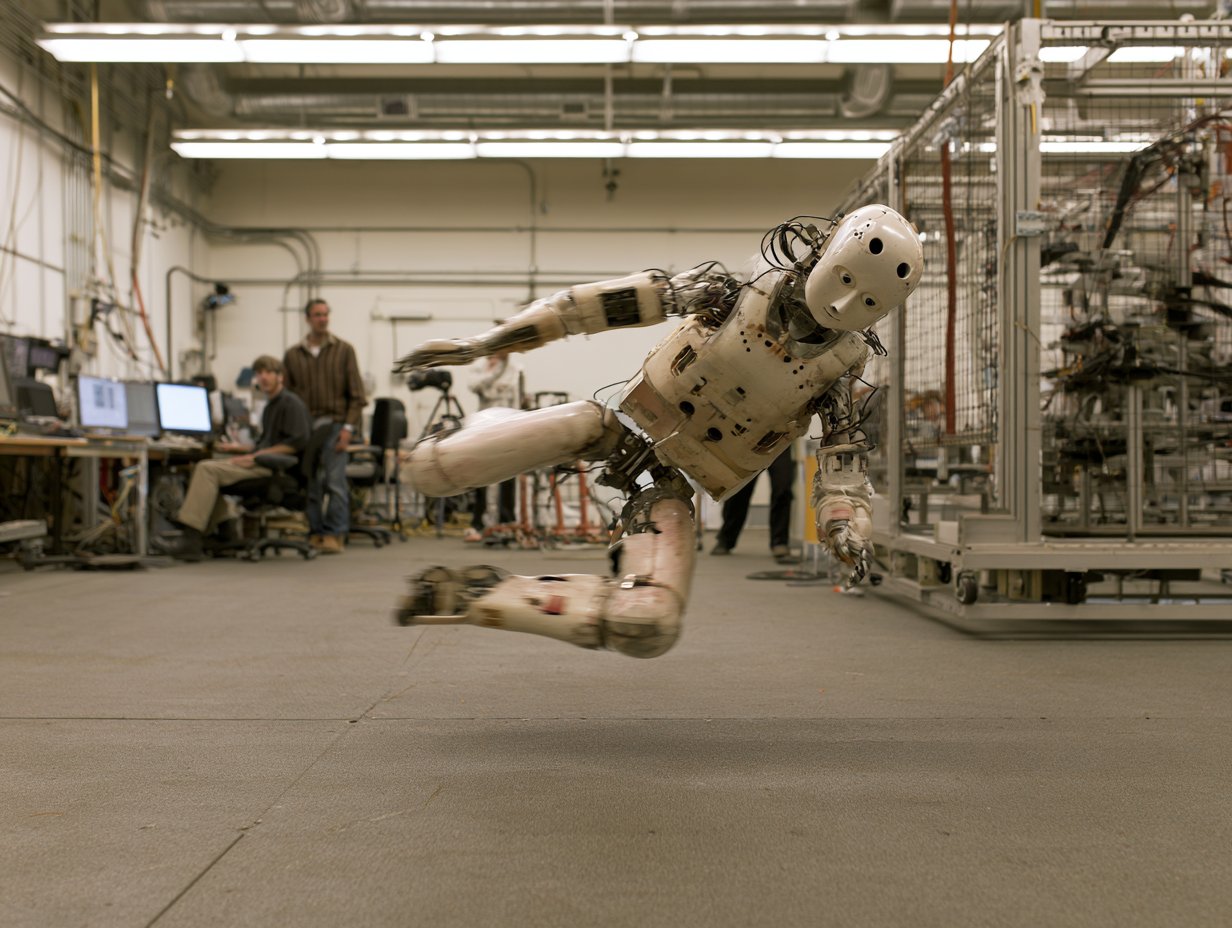
You do not even have to picture an injured person, as heavy as that scenario is. A conveyor belt is enough. One humanoid down in the line and the line stops. Siemens puts the cost of unplanned downtime in automotive production at 2.3 million dollars an hour. That is around 600 dollars a second while somebody picks the machine back up and nobody knows why it fell.
You can already see the consequence at the edges of the industry. The first household humanoid actually being shipped to customers (Neo by 1X) comes with conditions attached. No hot or sharp objects at first, no households with small children. In factories, humanoids run in tightly drawn pilot zones, watched and fenced off. That is where the sales argument tips over. A universal robot for the human world that has to be kept away from humans for safety reasons is not a universal robot for the human world.
The counter-design has existed for a long time, it just bores the cameras. A torso with two arms on a wheeled base reaches the same workbench, lifts the same crate and cannot tip over by construction. It also stands stable with the power off. Mobile manipulators of this kind are going into series production right now, from established makers of mobile robotics to startups with nine-figure funding. They solve the energy question and the safety question at once and pay for it with a single sacrifice. They cannot climb stairs. Anyone who knows a factory floor might pause to count how many stairs sit in the material flow there.
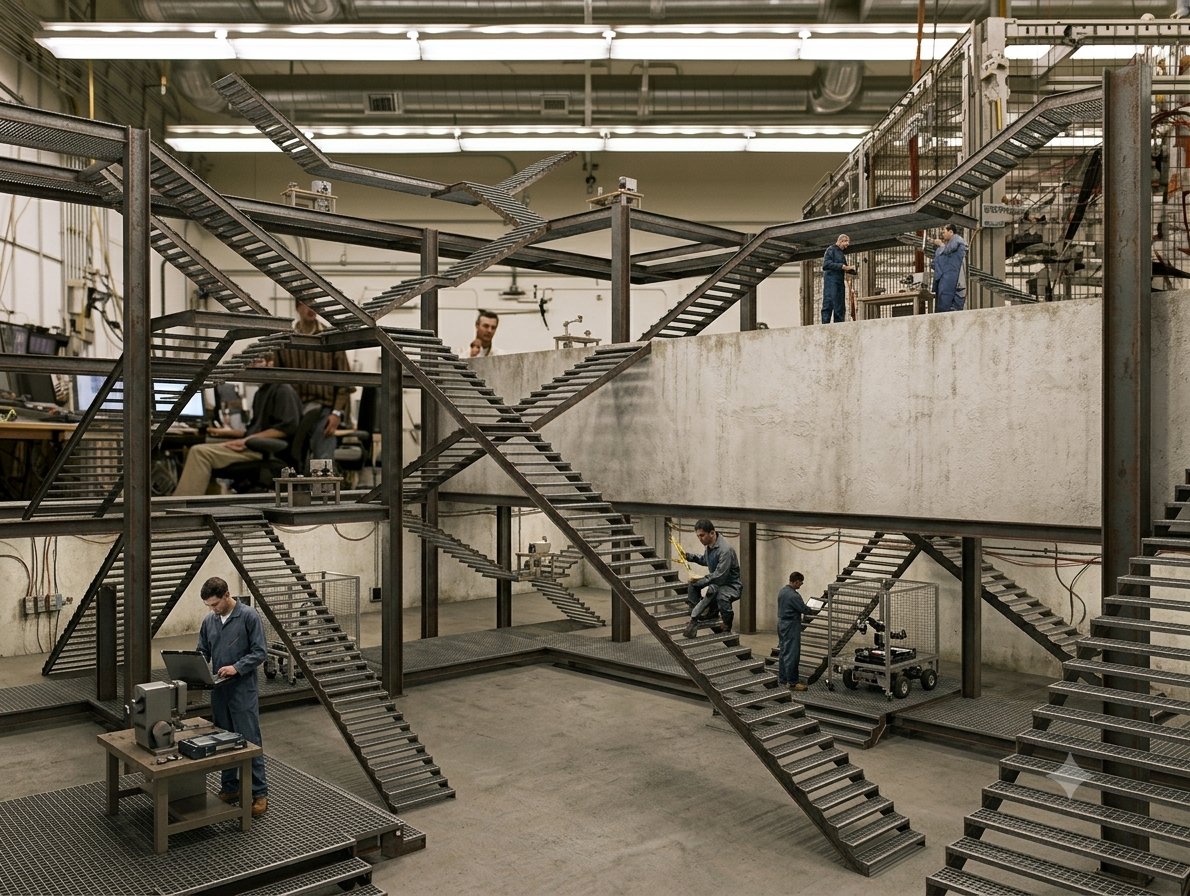
For decision makers this does not mean writing humanoids off. It means thinking from the job rather than from the form. Which task, which environment, which volume, which risk. Sometimes the answer will be a biped, in unstructured terrain that really was built for people. Most of the time it will not.
In April, Bitkom surveyed 555 German industrial companies. 63 per cent consider humanoid robots important for their future competitiveness. 6 per cent actually use them. What sits between those two numbers is not a procurement problem. It is the hype.
My scepticism is aimed at the stage, not at the engineering. All the more reason to ask the question the hype skips. The human environment needs robots that fit into it. It does not prescribe that they stand on two legs to do so. Two legs are a bet.