
Products made in Germany still have a worldwide reputation for precision and reliability. They are tested and refined until they work under any conditions. That is one side of the coin. The other is overengineering, meaning technology that is more elaborate than it needs to be. It reaches the market late and often costs more.
With new technology, that habit can get expensive. Germany does world-class research, but the road from the lab to the perfect product often takes too long. What people end up buying frequently comes from the US and, more and more, from China. The MP3 format was developed at the Fraunhofer Institute in Erlangen, yet the big money went to device makers like Apple with the iPod.
Germany cannot afford a repeat with the next generation of robots. These robots use AI and learn from data, and their foundations have been laid in German labs since the 1990s. They only get better in operation, though, on real lines and with all the mistakes that come with it. Wait until they are finished and you leave the experience to others.
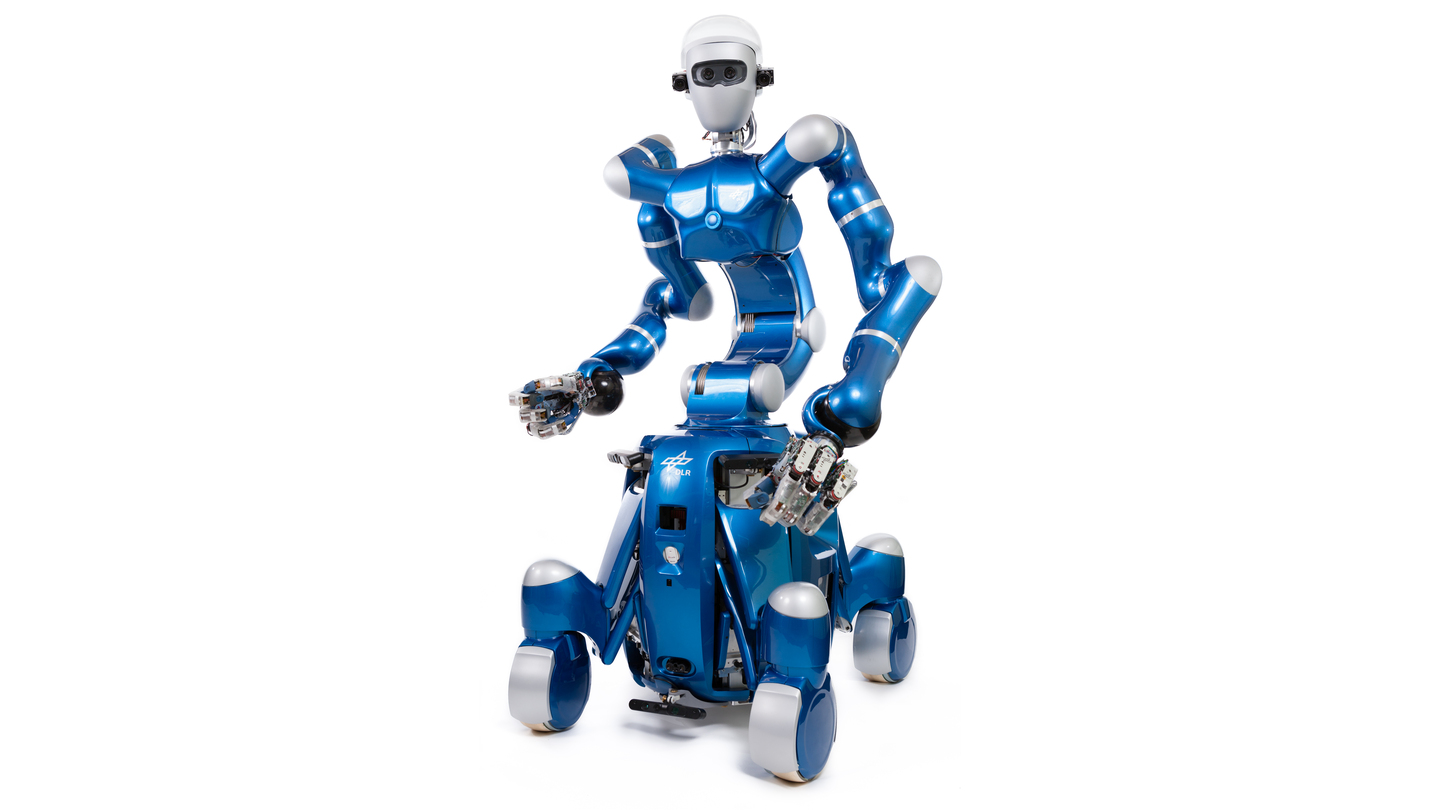
Back in 2008, almost 18 years ago, DLR presented Rollin' Justin, an early working humanoid. (Photo: DLR, CC BY-NC-ND 3.0)
Ralf Koeppe knows both sides of this question. In the 1990s he worked at DLR, the German Aerospace Center, on an arm that had to be light enough for space. The DLR arm could feel in every joint when it bumped into something. That meant you could guide it by hand, and it could work next to people. Ralf's own research was on having a person demonstrate a movement once so that the robot could reproduce it using neural networks. At their core, humanoids learn the same way today, he says, only in a broader context and with larger networks.
At KUKA, Ralf Koeppe developed a new generation of industrial robots and a new controller before leaving the company for management roles at Bosch Rexroth and WashTec. Today he trains supervisory board members and teaches robot systems at the University of Stuttgart.
In our conversation, Ralf explains why Mercedes put an unfinished robot into series production in 2009 and why hardly anyone dares to do that today. He also talks about how fast China is moving right now, what Mercedes is showing in Sindelfingen, and who is supposed to bring the new robots into the plants in the first place.
Marc: You brought the lightweight robot from DLR to KUKA. What did KUKA have back then, and what was missing?
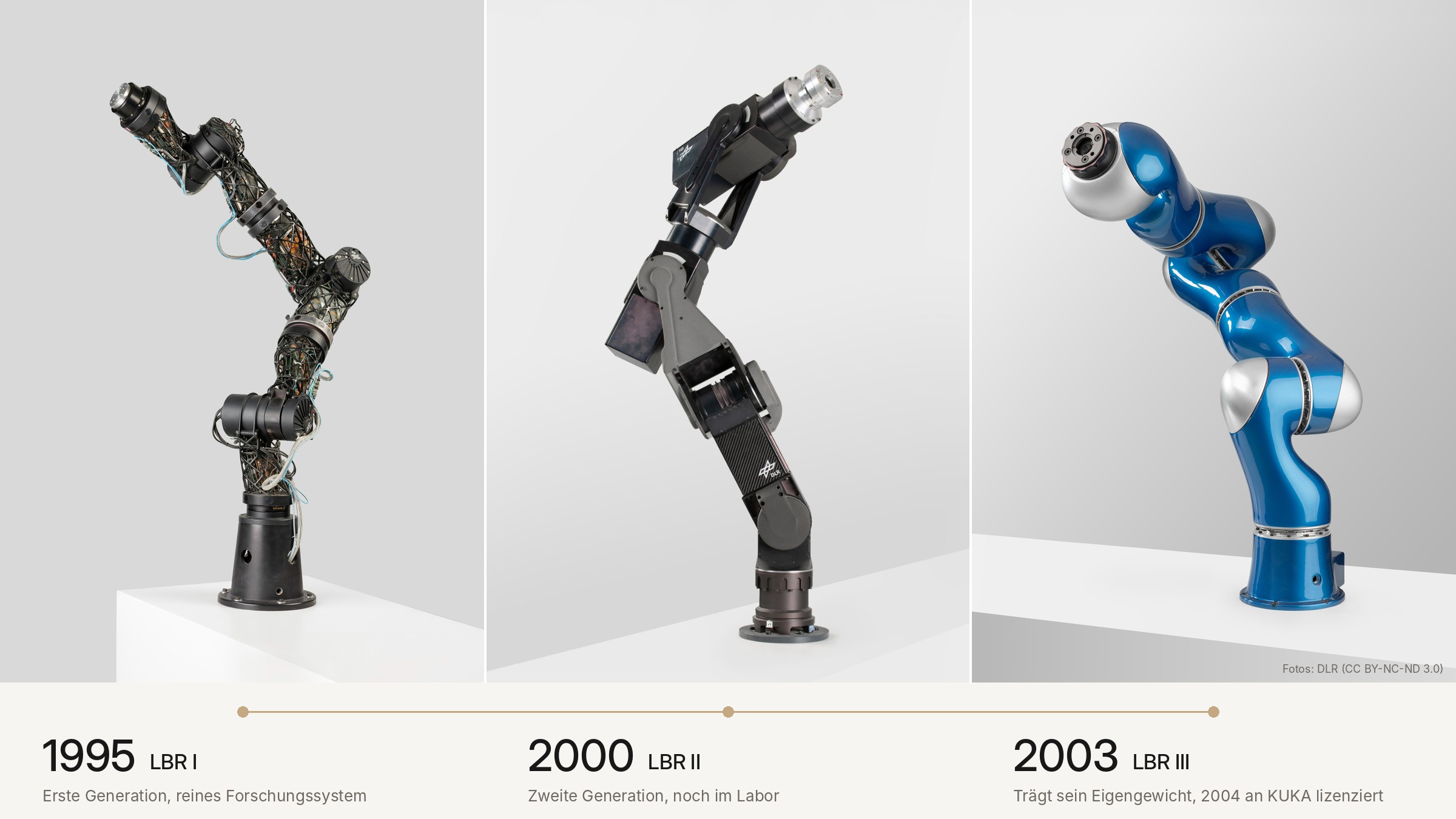
Ralf: Shortly before I joined KUKA, I had proposed marrying the lightweight robot with the KUKA controller. The idea was to program and operate it from the KUKA controller so that industry could try out this sensitivity for itself. We then did that in a publicly funded project. At KUKA I was soon put in charge of all development. KUKA had the mechanics and the software, but it did not yet have the mechatronic understanding needed to develop robots model-based and run them at peak performance. At the same time, the industrial robots and their controller were due for an overhaul. That was the situation in which the decision was made to bring the lightweight robot from DLR to KUKA through a technology transfer.
Marc: How did you turn the lab robot into a product?
Ralf: We started by building 20 replicas of DLR's third-generation lightweight robot, the metallic-blue carbon-fiber arm. A handful of DLR and KUKA design engineers improved it, and we hooked up our controller. At Automatica 2006, the robotics trade fair in Munich, we showed the first demos, learning by demonstration for example. After that we built another 60 units of the next generation, the orange LBR 4, to take the robot to market. We created a fast interface so it was easy to program, and many universities and research institutes bought it. That was a good starting position. It gave us a head start in application development, and at the same time we could supply research with tools.
Alongside the lightweight robot, we built up autonomous navigation and mobile robotics, in part through a technology transfer from the University of Freiburg. Today you would call that new robotics. In 2011 we moved all of this into KUKA Labs, a separate unit that I joined as technical managing director. That unit gave us the focus to bring these advanced products to market.
Marc: From 2009, Mercedes had the LBR 4 assembling rear-axle gearboxes at its Untertürkheim plant, more than half a million by the end of 2012 according to DLR. Was the robot finished at that point?
Ralf: Mercedes, one of the big customers that drive innovation, grabbed the lightweight robot and was very bold about it. The robot already performed well. It still needed looking after when it came to the endurance the automotive industry demands, but it was running in live production in the factory. So we were able to get even this pre-production version into applications very early and prove it there. For me, that is the difference from today, because with humanoids it has not worked that way so far. They run in separated, monitored areas where trials and pilots take place.
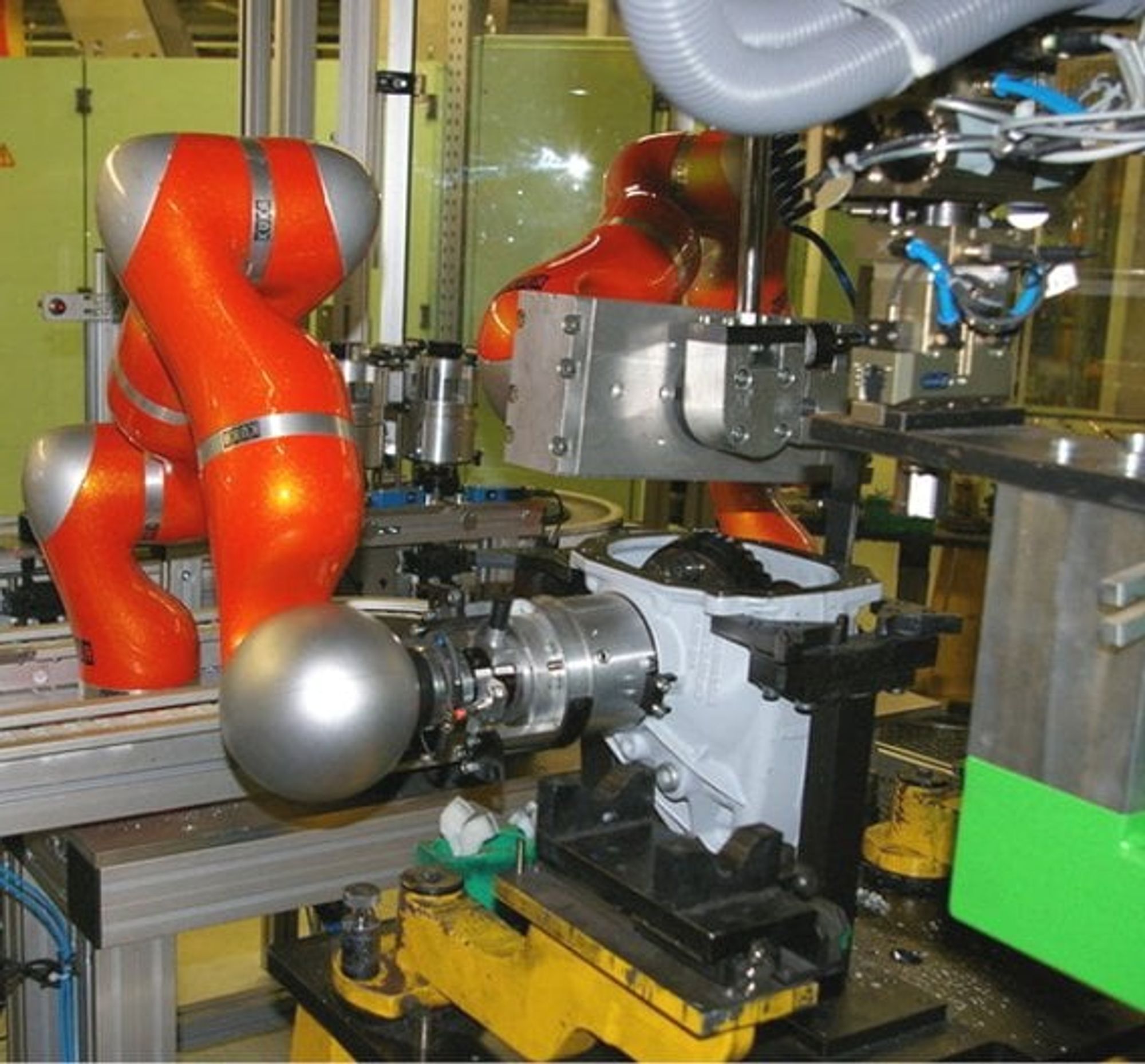
The orange LBR 4 assembling gearboxes in Untertürkheim. Supervision included. (Photo: KUKA)
Marc: KUKA launched its successor, the LBR iiwa, in 2014. You took a completely different route there than you had with Mercedes. Why?
Ralf: The iiwa was the series product, with launch customers in the automotive industry. We only delivered the first iiwa robots to Mercedes after a 1,000-hour test. Every joint was driven from end stop to end stop at high speed, so under heavy load. The cooling had to work, and of course some robots cut out at first, or grease leaked. Then you had to go back to the seals. That is how you engineer the quality in.
Maybe it did not have to be done that way. Our first customer was the car industry, though, and it demanded a robot that still works when it is 45 degrees Celsius in the factory, for example. Perhaps that was the route open to KUKA. An easier route would have been to enter through general industry.
Marc: What would have made you faster?
Ralf: A lot of what a young company can buy off the shelf today, we had to develop ourselves, from dual-channel joint torque and joint position sensing to electronics designed to meet the robot safety standards. Some of the sensors were developed with partners, including startups that came out of DLR. From the start, the iiwa was meant to be a robot with safety-rated collision detection that also came with the standard safety functions of industrial robotics. Safety engineering like that takes time. You need the experts for it, and you have to get through certification by TÜV. It could have been sped up by introducing the advanced safety functions at a later stage. A two-step approach would have required two electronics developments, and we had neither the capital nor the capacity for that. The iiwa was developed in parallel with ongoing industrial robotics projects.
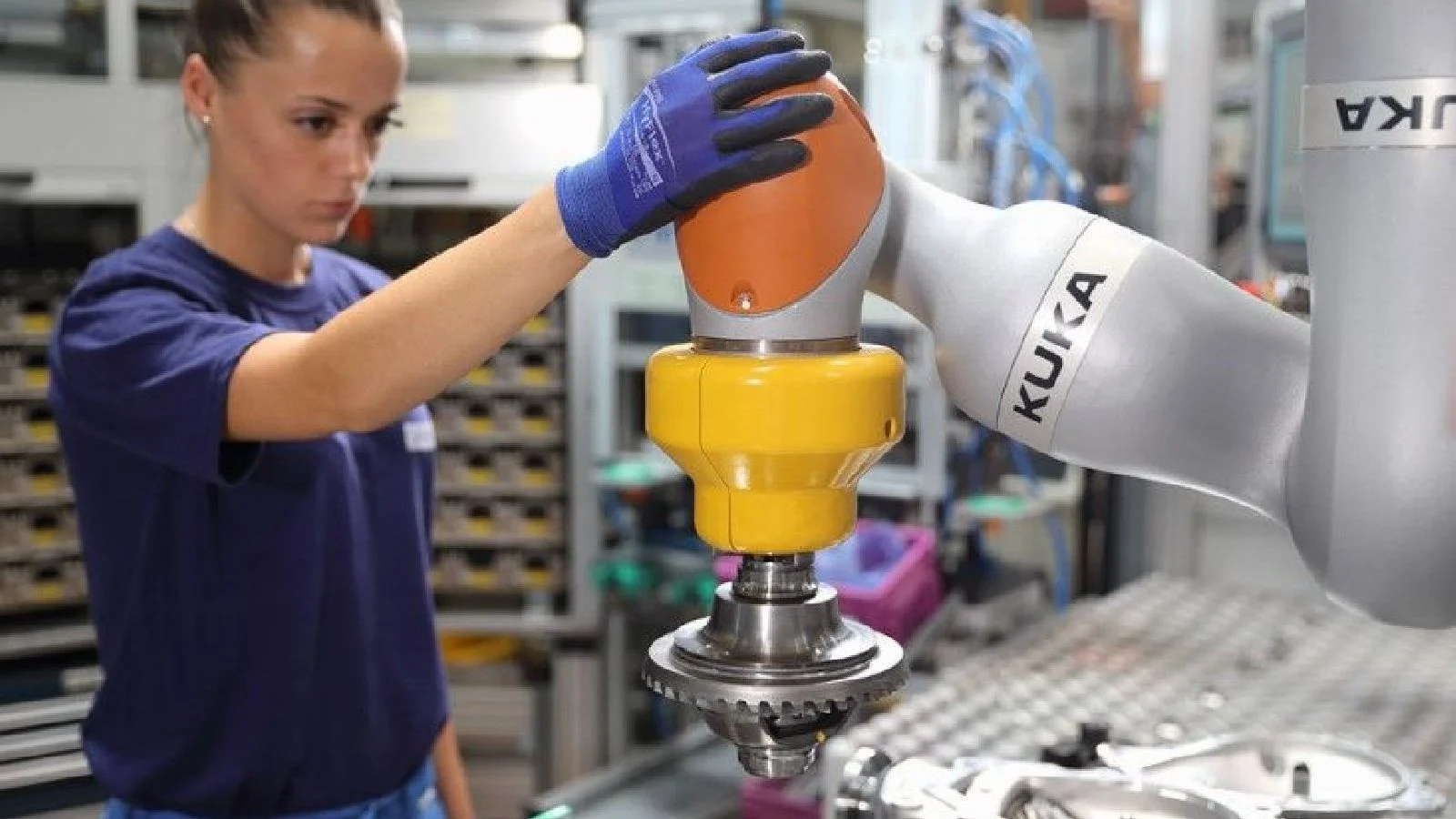
The LBR iiwa at BMW in Dingolfing. (Photo: KUKA)
Marc: An integrator once told me, talking about collaborative robots, that his robot does not need to work with people at all. Is he right?
Ralf: Of course there are advantages if a robot like that lets you do away with the safety fence. In practice, though, collaboration was overrated. Very few applications really work hand in hand with a person, and when cycle time matters, I would rather take an industrial robot. Sensitivity in the joint is still the step toward physical AI, meaning robots that use AI to understand their surroundings.
Marc: You often hear in the industry that Germany has fallen behind. Do you see it that way too?
Ralf: Technologically, we were early. I am very DLR-minded on this, because I come from DLR's robotics institute. Alin Albu-Schäffer and his team at DLR had Rollin' Justin, a two-armed robot on wheels, as early as 2008, and the two-legged TORO in 2013, developed entirely with model-based, compliant control. Everything was there. The basic physical technologies that humanoids need can be found in China, in the US and in Germany alike. On AI models and data centers we are catching up. Europe has its first startups that have mastered this technology.
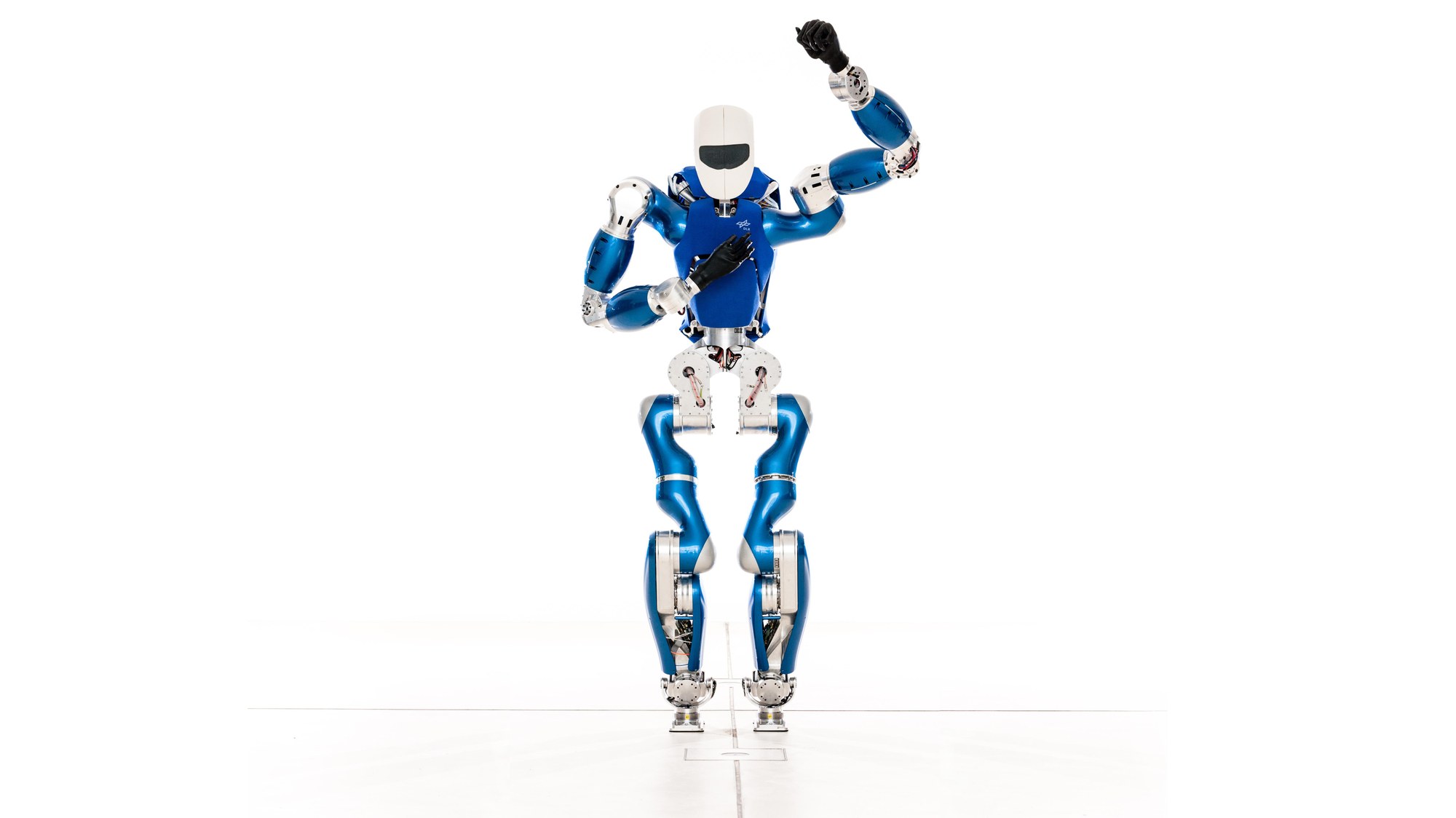
TORO, DLR's two-legged humanoid from 2013. (Photo: DLR, CC BY 3.0)
I think we Europeans are very focused on usefulness. The dancing robots with their kung fu moves are very impressive, but we immediately ask where they can be put to work and what benefit that creates.
Capital is an issue, of course. China and the US offer startups favorable conditions here. Europe is catching up right now. We are good at hardware engineering. The component supply chain, however, has largely taken shape in China, where parts can now be bought very cheaply. Massive state investment under the strategic program Made in China 2025 puts the momentum there in a different league. That does not mean we have been left behind. With the new geopolitical situation, we have to rebuild the supply chain ourselves. The first European companies, from scale-ups to automotive suppliers, already have initial offerings on the market.
Marc: Since this spring, according to both companies, robots from AGIBOT have been working in tablet production at the Chinese electronics manufacturer Longcheer, with two arms, a head and wheels. Are the Chinese simply faster?
Ralf: The Longcheer installation demonstrates a first production system with two-armed humanoids on wheels. Moving quickly into new production systems makes it possible to feed experience back into product improvements early. Last week, Google DeepMind and Mercedes-Benz published their progress on a picking and sequencing application (kitting) at the Sindelfingen plant. Apptronik's humanoid Apollo carries out these tasks with multi-fingered grippers. The application demonstrates what the DeepMind AI model can do in one specific task. Both examples show that real factory environments can yield insights early on.
Apptronik's Apollo 2 sorts components at a Mercedes plant into the order the line needs them. (Video: Google DeepMind)
Switching to new humanoid production systems means taking out the classic clickety-clack hardware, the automation mechanics we all know. In its place come robots whose movements are defined by a combination of different sensors and software. That is software-defined manufacturing. The humanoids can run on a mix of classic path planning and AI-guided motion or, as in the Mercedes application, be driven more or less end to end by the AI.
I have to take this bold route, because then I also find out sooner what works and what does not. I am convinced that a lead comes from application experience. Applications drive product maturity! If I have had a technology running in a factory for three years and kept optimizing it, I am ahead of anyone who is bringing a new robot model into production.
Marc: Who is supposed to gather that experience here?
Ralf: Large companies are testing these robots here. The Mittelstand, Germany's mid-sized companies, and mechanical engineering are going through hard economic times. If that is where you come from, you may not have the capital or the people to try things out playfully. So perhaps the large companies need to lead the way with their production sites and gather experience. Providing a robot gym is another good approach here. If we do not get into industrial applications now, it will be difficult. For me, that is the critical point.
Marc: Who brings these robots into the factories? The traditional system integrators?
Ralf: It is an open question whether the humanoid makers will do everything themselves or whether there will be system partners again. Industrial robotics would never have spread so quickly without system partners. They built thousands of applications. Many of today's integrators tend to think in metal, electronics and mechanical engineering, though, and physical AI adds something very new in kind. Vision is one example. Computer vision used to be a separate project mounted on top of the robot, and commissioning it was laborious. Depending on conditions such as lighting and reflections, it took a lot of effort to reach the required effectiveness. Today, or so physical AI promises, vision can be built into the product, handled through learning algorithms and combined with language and touch.
If I automate with a software-defined structure, the system integrator also has to be a software company that knows how to handle data. The traditional integrators may well develop in that direction. That takes investment and the opportunity to gain experience with these new technologies. A real transformation. For this shift, employees need new skills.
Marc: Say you sit on the supervisory board of a company that wants to bring a humanoid into its factory. What do you recommend?
Ralf: First you look at the different applications in the company and pick several pilot candidates. You assess them for desirability, feasibility and viability. Is this a task I would like to see automated because the job is so strenuous that nobody wants to do it? Is it technically feasible, and does it pay off? That gives you a ranking. Only then do you choose the system, and it does not have to be a humanoid. A first physical AI pilot can just as well be done with a sensitive production assistant or an industrial robot.
Marc: What needs to be in the plan for the pilot?
Ralf: As a board member, I would expect several scenarios to be calculated. What does success look like, and within what range can I observe it? Can I scale? Do I have the task 20 times in the factory, 100 times or 1,000 times? A large corporation is playing a different game than a mid-sized company that may have exactly one or two such installations. For that company it is difficult at the moment. What happens if the integration effort is five times higher than planned, or if the system delivers 10 to 20 percent less? Do I still gain insight then? It is similar when the robot replaces minimum-wage labor. In all of these cases, payback is very demanding. I simply want to know that the team is not going into these projects naively. That has nothing to do with being risk-averse.
For me, Ralf's story holds a large part of the answer to what we are missing right now. In 2009 Germany had both, a robot from top-level research and a factory that let it into series production while it still needed looking after. With its successor, everyone played it safe, with 1,000 hours of endurance testing and advanced robot safety functions from day one.
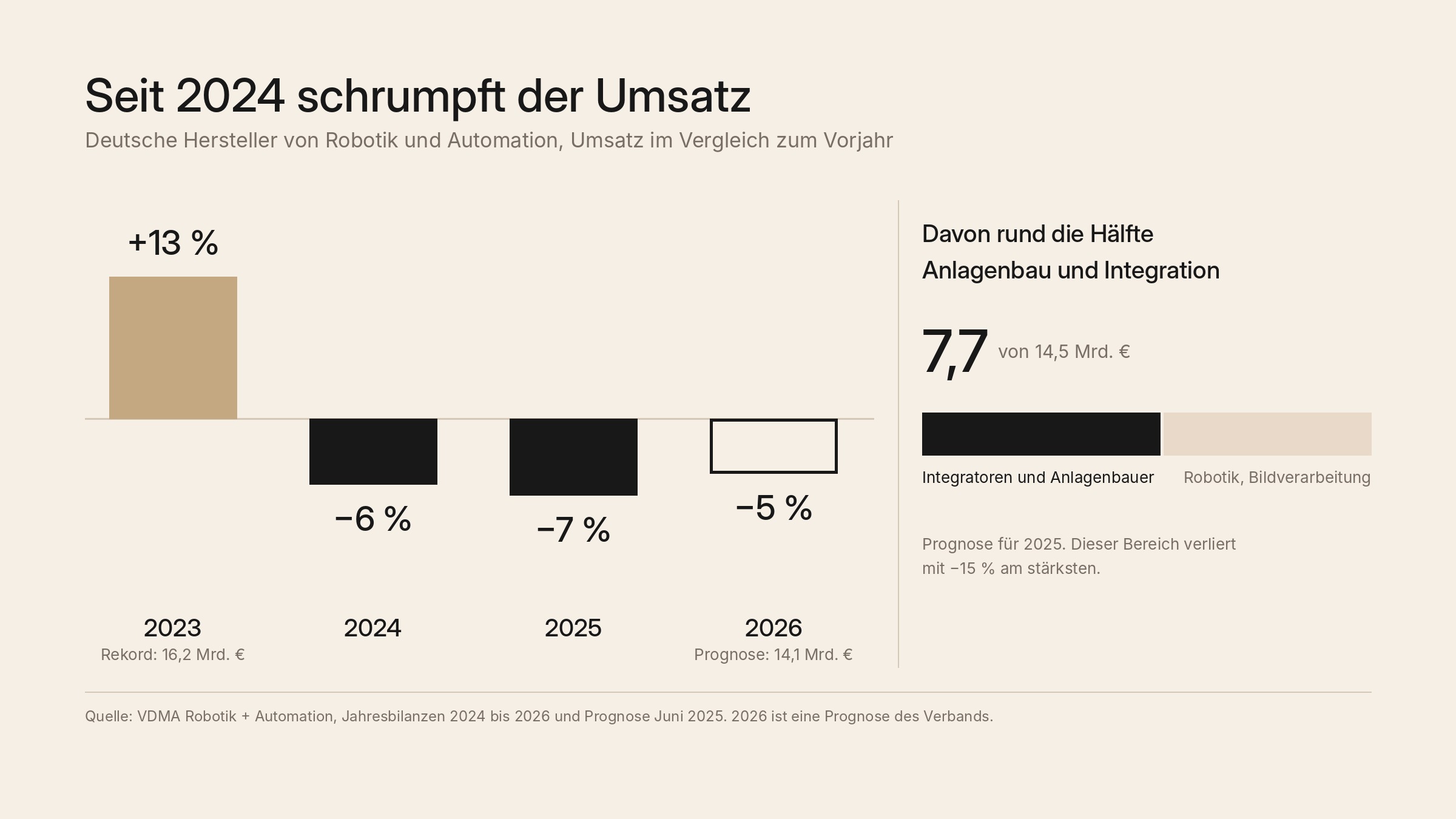
The hesitation has good reasons all the same. In Germany, robotics depends on the car industry, which buys almost a quarter of the robots and is itself under pressure. Anyone on shaky ground there is unlikely to take a light-hearted gamble on a robot that still needs looking after. Others gather the experience instead.
I believe our math will change soon, as soon as autonomous systems can be brought onto a line at a fraction of today's effort. By then, the leaders will be those who have gathered experience and think in software more than in metal. Nobody has to give up thoroughness for that. It has its place when a product goes into series production. At the start of a new technology, though, it takes plants that let a robot with teething problems onto their line, the way Mercedes did in 2009. Otherwise the foundations will once again be laid in German labs, and someone else will make the money.
About Ralf Koeppe: Earned his doctorate at ETH Zurich and spent ten years in research at the DLR Institute of Robotics and Mechatronics in Oberpfaffenhofen. Then 12 years at KUKA, as VP R&D of KUKA Roboter and technical managing director of KUKA Laboratories, followed by CTO of the Automation & Electrification Solutions business unit at Bosch Rexroth and CTO and CEO of WashTec AG. Today academic director of the Institute for Supervisory and Advisory Boards at Steinbeis Augsburg Business School and lecturer in robot systems at the University of Stuttgart.
About Marc Eyrich: Strategic communications for physical AI and robotics, with Lucent, based in the Stuttgart region. Has been communicating complex technology for more than ten years, for tech brands on the agency side and in-house at a robotics company. Builds physical AI brands with founders, from positioning through identity and website to film.