
For a while now I have been circling the question whether robots should really look like us. Every time I think it through, I hit the same walls. A machine that balances on two legs will fall, and a falling machine of steel crushes whatever is underneath it. And the tendon-driven hand, the most human part of these robots, is extremely complicated and fragile. Still, the humanoid form keeps pulling everyone in. The founders, the capital, the attention, and I still cannot fully understand why. Then Aaron turned up in my comment section, and the robot he builds has neither of these problems.
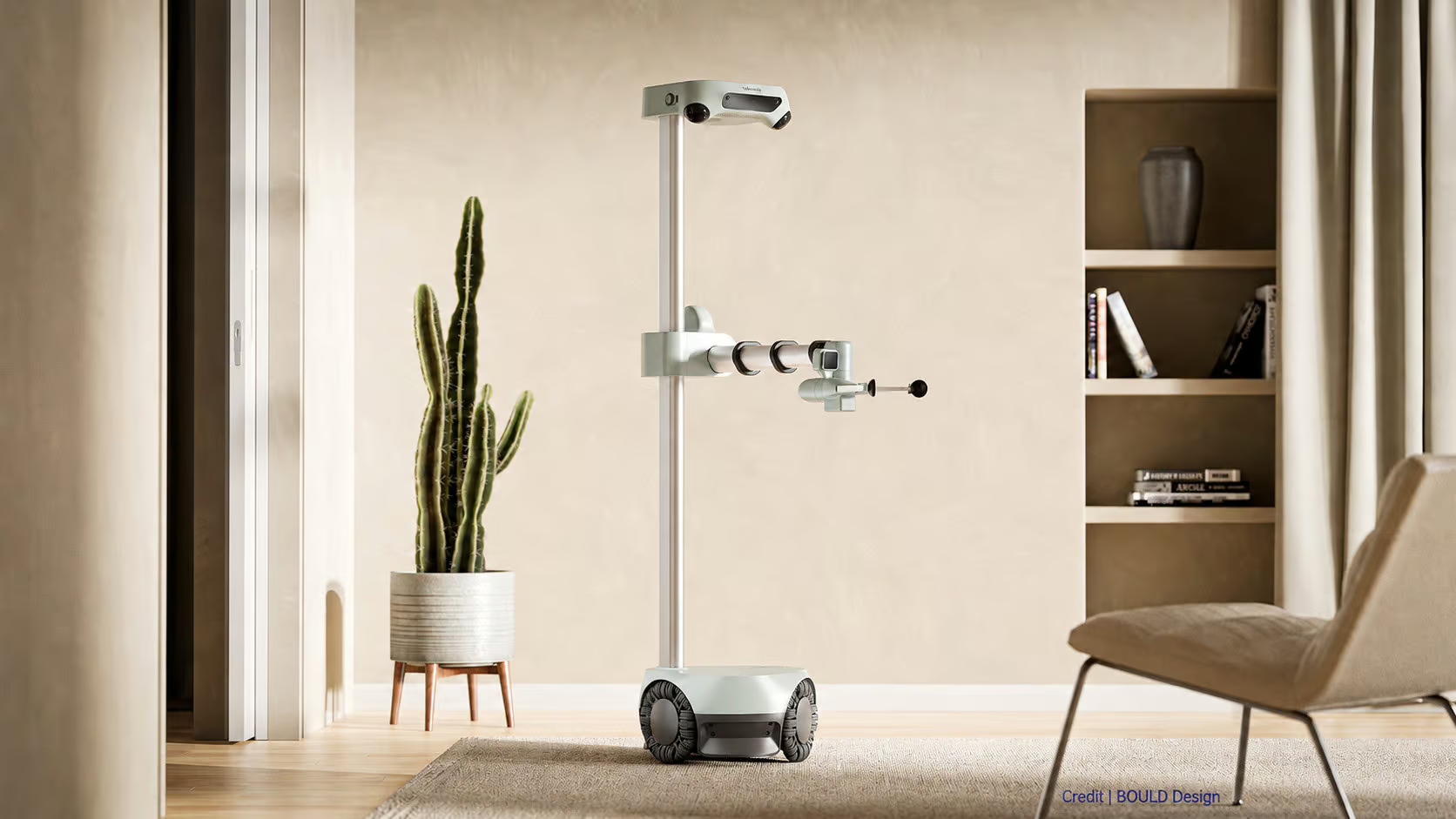
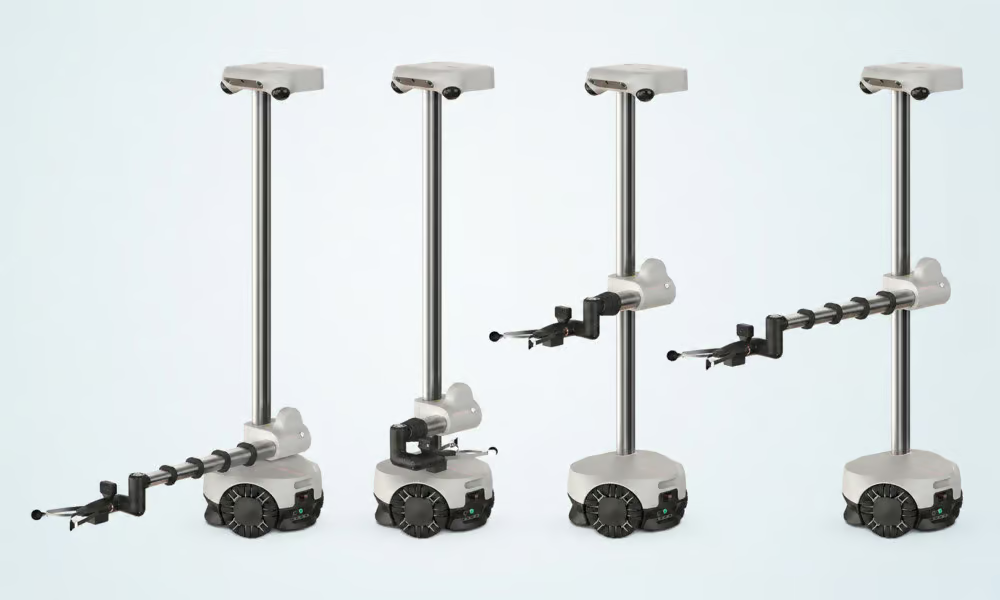
His robot Stretch is a slim pole on a wheeled base with a telescoping arm and one simple gripper. Roughly the height of a person but looks nothing like us. Its weight sits at the bottom instead of in a torso that can fall, and its gripper has one degree of freedom instead of a dozen tendons waiting to fray.
What made me sit up was Aaron's own story. It began in the San Francisco robotic art scene of the early 1990s, where he built robot sculptures for the stage. From there he went through a computer science degree at Stanford to MIT, where he started working on humanoids in 1999 and earned his PhD in Rodney Brooks' Humanoid Robotics Group with a dissertation titled "Robot Manipulation in Human Environments". With his humanoid Domo, one of Time's best inventions of 2007, he became one of the true pioneers of the field.
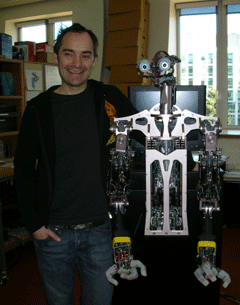
In 2007 he founded Meka Robotics, which sold humanoid arms, torsos and hands to research labs around the world. Google bought the company in 2013, and Aaron spent the next four years there as Robotics Director.
In 2017 Aaron founded Hello Robot with Charlie Kemp and started over, this time without the human form.
Why does someone with this much humanoid experience suddenly build a completely different form of robot? Curious, I sent Aaron a few questions, which he answered for this article.
Marc: When you started with humanoids at MIT, it was a research field with a small circle of people in it. Today it is the loudest story in robotics and the money is enormous. Does that surprise you, or did you always expect it to arrive at some point?
Aaron: Honestly, it's fairly incredible. It's hard to imagine where we are today from back then. When I first started in humanoids in 1999, we had two giant racks of computers that would do very simple things like visual servoing to a colored ball and coordinate joint motion. Ideas like dexterous manipulation and real-time interaction with people were just emerging as possibilities. We barely had depth sensing, and getting stereo imagery took months and months of effort to set up the infrastructure. So it always felt very speculative, and when I started my first humanoids company in 2007, we could only imagine ever being in the research space. We never even tried to raise capital because that was an obvious impossibility at the time. So truly, the physical AI moment that is here was difficult to imagine. Even when I was at Google and we were discussing and inventing some of the early aspects of physical AI, it was hard to imagine the rate of progress that we are seeing today.
Marc: You spent years building humanoids before you built Stretch. Was there a moment where the human form stopped making sense to you?
Aaron: Yes, as we really dug into what it would take to have robots out in the world, working with people, and at a price that made sense, it became clear that the complexity was a fundamental barrier. It's super challenging just to keep a high-degree-of-freedom robot working reliably; regardless of the level of resources and engineering talent, just the math of mean time between failure across all the systems is very hard to work out in a production setting. In addition, if you take seriously the proposition of building a business around a robot, you have to be pragmatic and put aside science fiction dreams. So while I was at Google advocating for a minimalist approach to a home robot, the direction veered towards being much more complex. At that moment, I knew we had to make a considered bet on a minimalist approach if we were ever going to see these robots in the home.
Marc: The argument for a human-like robotic form everyone repeats is that the world was built for humans, so the machine should be built like a human. What do you think about that statement?
Aaron: I think that statement is a bit naive. I've made it in the past when I did humanoids. But really the important aspect is that human environments have regular structure; for example, door knobs are at a typical height, floors are flat, cabinets are right at a certain height, and there are lots of horizontal surfaces that we put plate objects on, etc. So that structure can be leveraged both in the algorithm and in the hardware, and you want the overall robot system to be well-matched to its environment, whatever the environment is. So while humanoid forms obviously fit well in the human environment, there's a whole world of alternate forms that can also exploit this structure. And they can do it much more efficiently in terms of cost and complexity. By simplifying the form we get all sorts of downstream advantages in terms of computational complexity, reliability, safety, etc.
Marc: A humanoid made of steel with a weight of 80 kg (around 175 pounds) that falls over in a living room crushes whatever is underneath it. Do you think that problem is solvable?
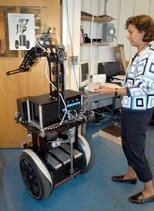
Aaron: I think that problem is very difficult to solve with current mechatronics approaches. The fundamental physics you cannot cheat. If you think about the potential energy that's inherent in a dynamically balancing system, when that goes down, there is not much that can be done. While at MIT, I built one of the very first dynamically balancing systems, which was based on the Segway with an arm on top. When it fell over, it was very frightening, so then I developed a kickstand that would deploy to keep it from toppling. But just the energy of those kickstands was threatening and they could punch a hole in the wall. So fundamentally, physics is against putting dynamically balancing systems in constrained home environments around vulnerable populations like kids, pets, and older adults. To solve it, we need a fundamentally different type of mechatronics based on lightweight, compliant, low-effective-inertia systems. I've seen interesting research in this direction, but I think it's far from production.
Marc: You built humanoid hands for close to a decade and your robot ships with one simple gripper. What does that gripper give up, and how does it compare to a mechanical tendon-driven hand?
Aaron: Our current robot has a single degree of freedom. It is based on an adaptive grabber tool that was the highest-rated tool on Amazon. So we crowdsourced the design, effectively. It does a lot of things pretty well, but certainly can't do all the things a human hand can do. Our proposition is that even the range of things that just a gripper can do has high value given the right user needs. Let's start with something that's robust, inexpensive, and reasonably capable before we bring in all the complexity of dexterous hands. The issue with these high-degree-of-freedom hands is that, fundamentally, the motors need to be small yet impart high torque and forces that cannot be avoided. The thermal limitations of these motors make it physically near impossible to achieve force and reliability requirements given the power efficiencies of the motor.
In addition, cable drive systems, as used in many dexterous hands today, are notoriously challenging to keep working. The cables like to stretch, they act as abrasive saws and saw through structures, and even the best cable systems tend to fray, break, and wear over time, particularly given the compact cable routing challenges of dexterous hands.
Marc: Do you think bipedal humanoids will eventually work in homes? What would have to be true for you to build one?
Aaron: I think that the way that bipedal humanoids come into homes is that as a society, we agree that the safety risks are worth it. We do this with cars today; we agree that a certain amount of casualties per year is acceptable given the value. I think it will take a long time for us to get to that point, and hopefully the systems become much, much safer in that time. Fundamental issues around the potential energy of these systems, the pinch points, and high forces required at the joints make them hard to imagine in the next 10 years in a safe deployed setting.
What I really like about the philosophy behind this robot is that it puts the human at the center. Elsewhere robots are boxing in rings, running marathons and being staged as a kind of replacement for us. The machine as a supplement for an aging society. To me Stretch stands for the opposite idea. It is a machine built to help us, and it helps today, not in some distant future. I know which of the two visions I'd want in my living room.
Stretch is minimalist and pragmatic in the best sense, because the fundamental problems are solved instead of postponed. This machine cannot really fall on anyone. Its manipulation is nowhere near a human hand, but I keep asking myself which tasks actually need one. Loading a dishwasher is probably out of reach, and folding laundry takes two arms. But picking up what fell to the floor, fetching a blanket, opening a drawer, wiping a table, bringing the phone that is lying out of reach, all of that is one gripper's work. Everyday assistance is made of exactly these moments.
Real value means a real improvement in someone's life, and that is exactly what Stretch delivers. Henry Evans, paralyzed since a stroke and testing assistive robots in his own home for fifteen years, lived with Stretch. He has used it to brush his hair, to eat and to hold his own playing cards for the first time in two decades. "It was practical, and I could see using it every day," he told MIT Technology Review after a month with the machine. I find this kind of help far more impressive than a robot that jumps 3m or runs faster than Usain Bolt.
A pioneer of humanoid robotics builds a robot that avoids the humanoid form, out of everything twenty years inside that form taught him. It stands on ballast instead of balance, grips with one degree of freedom, and costs 29,950 dollars. However the humanoid story ends, Aaron has placed his bet, and his robot is ready for the homes the industry is still promising to reach.
About Aaron Edsinger: CEO and co-founder of Hello Robot, maker of the Stretch mobile manipulator. He has founded four robotics companies for human-collaborative robots. Two of them, Meka Robotics and Redwood Robotics, were acquired by Google in 2013, where he then served as Robotics Director until 2017. He holds a PhD from MIT CSAIL, where he built the humanoid Domo.
About Marc Eyrich: Communications consultant based in the Stuttgart region. Founder of Lucent. He works with deep tech and industrial companies as an external communications lead, translating technical substance into clear customer value.